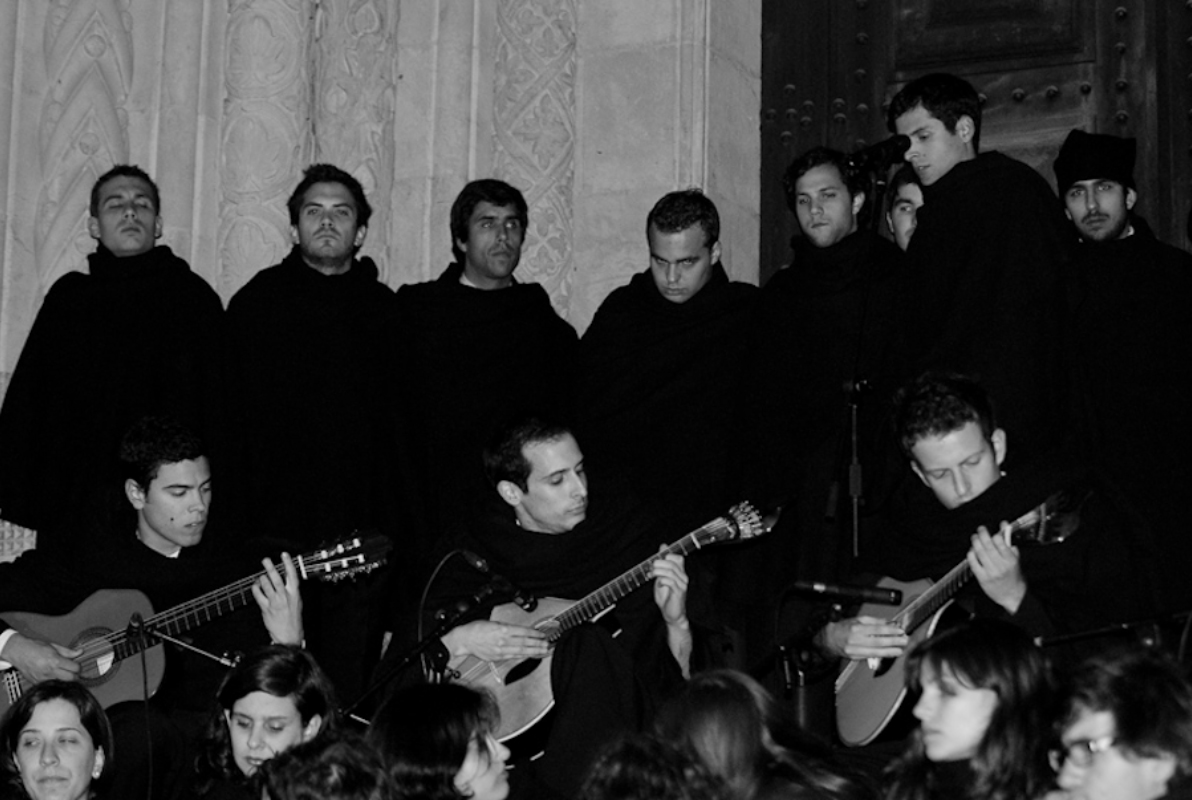

Canção de Coimbra can be learned through guided listening even when no participatory music lesson is available. Listen for the lower-tuned guitarra de Coimbra, the poetry, the serenade setting and the tradition around capa e batina; then apply one of those clues to the next song. The format is interpretation, not singing or guitar tuition.
The university setting is part of the music, not a costume added for visitors. Coimbra’s Monumental Serenade is associated with the Old Cathedral steps, midnight bells and the first notes of the Portuguese guitar. A daytime guide can use that setting to explain why place, hour and audience behaviour change how the song is heard, without pretending that every commercial performance recreates a student ritual.
A knowledgeable musician or guide should identify a small set of features—voice, Portuguese guitar, lyric, setting or university association—then compare two examples. One might reveal how the guitar answers a sung line; another might show how a lyric draws on absence, study or departure. You should be able to listen to a third and explain what you notice. A short historical speech before a concert does not provide the same active task.
If an offering claims to teach singing or guitar, ask for the named teacher, instrument, starting level, practice time and feedback. Choose participatory tuition when you want repeated playing or singing under correction.
Performance etiquette matters. Listen without turning the room into a classroom unless questions are invited, and do not assume that dress associated with university tradition is an invitation for staged photographs. A separate daytime interpretation session can prepare you to hear the evening performance with more understanding.
What we checked
Sources behind the local details
We used these sources for local history, geography and cultural context. Opening times, access and programmes can change, so confirm current details with the venue or host. Sources checked on 21 August 2026.