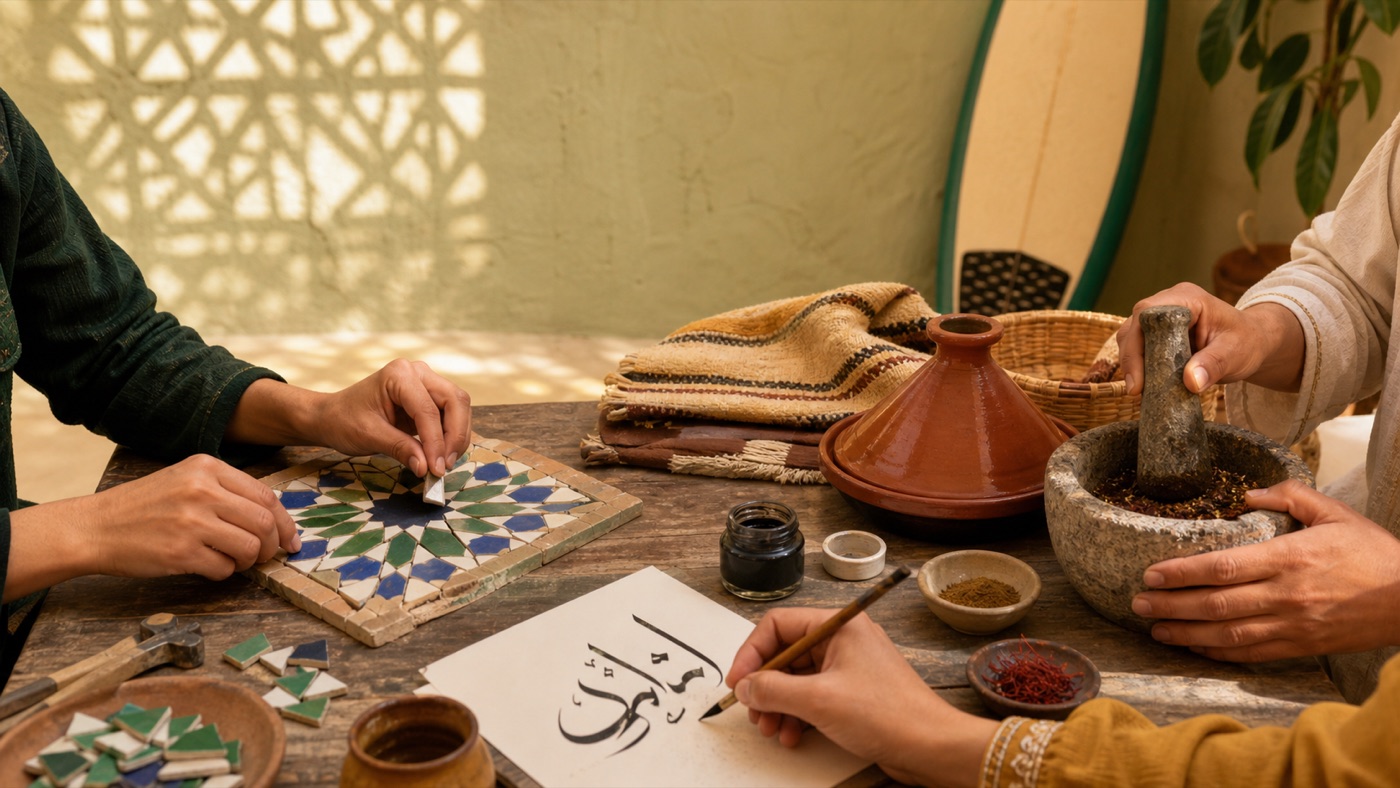
Choose the skill before choosing the pin on the map. Learn zellige and leather in Fes, Darija and northern crafts in Tetouan, surf around Taghazout, or desert astronomy near Merzouga. Then build the route around real teaching time—with a proper lunch, naturally.
Come to Fes for Arabic and deep craft traditions. Choose Marrakech when your group wants cooking, calligraphy and several workshop options. Essaouira brings Atlantic wind, Gnawa rhythm and visual arts together. Taghazout is Morocco’s clearest surf classroom. Imlil opens the High Atlas. Merzouga gives astronomy and desert skills the dark sky and landscape they need.
Choose the skill first, then the Moroccan place that teaches it naturally. Before arranging anything, ask who teaches, what you will practise and how much feedback you receive.
Morocco learning map at a glance
| You want to learn… | Start looking in… | A good session lets you… |
|---|---|---|
| Cooking and food culture | Marrakech, Fes, Rabat, Essaouira, Agadir | Choose ingredients, cook meaningful stages, taste, adjust and keep the recipe |
| Arabic or Darija | Fes, Rabat, Tetouan, Marrakech, Tangier | Speak at the right level, receive friendly feedback and try the sentence again |
| Pottery, zellige and craft | Fes, Tetouan, Marrakech and Safi-linked programmes | Touch the material, practise a real stage and understand finishing or firing |
| Surf and wind skills | Taghazout, Agadir, Essaouira, Rabat, Casablanca | Train in suitable conditions with a coach who matches your level |
| Mountain and landscape skills | Imlil, Atlas Mountains, Ifrane | Read the route, conditions and landscape with a suitable local guide |
| Desert astronomy and field skills | Merzouga and the Sahara | Use an observation method, understand the sky and work safely after dark |
| Music and visual arts | Essaouira, Tangier, Chefchaouen, Rabat | Learn with context, practise a clear assignment and receive useful feedback |
Four easy ways to start
Come hungry. Explore Moroccan cooking holidays when you want market knowledge, spice balance and a dish you can make again. Marrakech offers the broadest choice. Fes adds a distinctive Fassi food tradition. Essaouira and Agadir connect cooking to Atlantic produce and Souss ingredients.
Come ready to speak. Use the Arabic and Darija guide to separate spoken Moroccan Darija from Modern Standard Arabic. Fes, Rabat and Tetouan work especially well for structured study. Even a short lesson should give you phrases you can use beyond the classroom.
Come ready to make. Morocco’s craft workshops cover clay, zellige, fibre, leather, wood, metal and calligraphy. Pick the process before the souvenir. A fine first lesson may produce a small sample, not an entire museum piece before tea.
Come ready to move. Compare surf camps, mountain learning, riding and outdoor field skills. Conditions decide the day, especially on the Atlantic and in the Atlas. A good host changes the plan when the wind, swell, heat or snow says so.
Choose a place for what it can teach
Marrakech is the easiest first base when a group wants different skills. You can cook, study Darija, try calligraphy, explore craft or work on photography without changing hotels every night.
Fes goes deeper into how things are made. Pottery, zellige, leather, weaving and metalwork sit beside Arabic study and Fassi cooking. Bring curiosity and comfortable shoes. The best workshop door may not be the easiest one to find.
Northern Morocco offers three different classrooms. Tetouan combines Arabic, Andalusian-Moroccan culture, food and serious craft traditions. Tangier adds languages, painting, photography, music and a city shaped by the Strait. Chefchaouen connects Rif pottery, wool, painting, food and Darija. The blue lanes are lovely; they are only the opening paragraph.
Atlantic Morocco: choose the water skill before the hotel
Taghazout is the clearest base for progressive surf coaching. It also supports surf-and-yoga programmes when both parts are genuinely taught. Smoothie bowls are pleasant; they do not improve a pop-up without practice.
Agadir connects surf with cooking, Tamazight, argan, pottery, jewellery and the wider Souss. Essaouira is Morocco’s great multi-skill coast. Surfing, kitesurfing and wind sports sit beside Gnawa music, photography, painting, embroidery, thuya woodwork and cooking.
Rabat and Casablanca are not consolation stops. Rabat is strong for Arabic, cooking, craft, archaeology and Atlantic surf. Casablanca opens modern architecture, Darija, food, pottery, woodwork and Dar Bouazza surf. Choose them when a living city—not a resort bubble—is part of what you want to understand.
Mountains, Middle Atlas and southern routes
The Atlas Mountains hub separates the High, Middle and Anti-Atlas. They are not one convenient mountain backdrop. Imlil is the practical High Atlas base for walking, route skills, household cooking and village context. Ifrane and nearby Azrou open cedar forest, lakes, birdlife, seasonal snow, architecture and riding.
Ouarzazate combines film, earthen architecture, pottery, cooking, photography and solar-energy context. Aït Benhaddou is more focused on earthen building, history, photography, walking and local food.
The Sahara guide routes astronomy and desert learning towards Merzouga and the wider oasis systems. Not every dune camp teaches something. Sometimes a sunset is simply a sunset—and Morocco has no shortage of excellent ones.
What should a real learning experience feel like?
You should spend most of the session doing the thing you came to learn. The teacher demonstrates, watches your first attempt and helps you improve the next one. You leave with something useful: perhaps a recipe, phrase set, field note, small object or practice plan.
A tannery viewpoint can be valuable without becoming a leather class. A studio visit can explain filmmaking without handing you a camera. A market walk becomes a stronger cooking lesson when your ingredient choices shape the meal you prepare.
Meet possible hosts
GoLearnTo profiles schools, studios, cooperatives, guides and independent teachers that may fit the skill and place. Live dates and lesson details still need confirmation with the host.
Each profile shows published facts, practical contacts and the questions to ask before travelling. When we cannot find a suitable current host, the skill guide remains useful without pretending a class is available.
Plan less. Learn more.
For a first trip, choose one main base and perhaps one contrasting region. Fes plus Chefchaouen creates a craft-and-language route. Marrakech plus Imlil pairs city cooking or craft with the High Atlas. Essaouira plus Taghazout compares two Atlantic learning worlds. Ouarzazate plus Merzouga needs more road time but connects film, earthen landscapes, oases and night skies.
Protect the hours you came to learn. Check transfer times, rest days, seasonal conditions and access before adding another stop. A seven-day trip with two good lessons can teach more than a frantic week of ten “experiences.”
Cultural respect and programme boundaries
The site is intentionally alcohol-free. Cooking, wellbeing and social programmes must be able to confirm alcohol-free teaching, venues and inclusions rather than quietly removing one tasting from an otherwise unsuitable itinerary.
Respect means asking before photographing people or workplaces. It means noticing when a visit interrupts paid work and checking how the teacher benefits. Sacred practice, community heritage and household knowledge are not props. Arrive curious, listen properly and accept a boundary with good grace.
Open the guide that solves today’s question
The Morocco guide library covers routes, seasons, costs, accessibility, families, solo travel, Ramadan and workshop etiquette. It also explains subjects often blurred by tour copy: argan, carpet weaving, communal ovens, Gnawa, leather tanning, ras el hanout, tagine technique and zellige.
Use them to ask better questions. “Is zellige included?” tells you very little. “Will I cut tile, arrange pre-cut pieces, paint a tile or tour the workshop?” reveals the real format.
Tell us what would make the trip worthwhile
Include your dates, starting level, preferred language and the skill you want to practise. Add any mobility, dietary or family needs. Most importantly, tell us what you hope to bring home. A recipe, stronger pronunciation, a small object, better balance on a board or a clearer understanding of a place.
We will use those details to ask useful questions. An enquiry starts a conversation; it does not confirm availability, price, suitability or a booking.
What we checked
Sources behind the local details
We used these sources for local history, geography and cultural context. Opening times, access and programmes can change, so confirm current details with the venue or host. Sources checked on 14 August 2026.