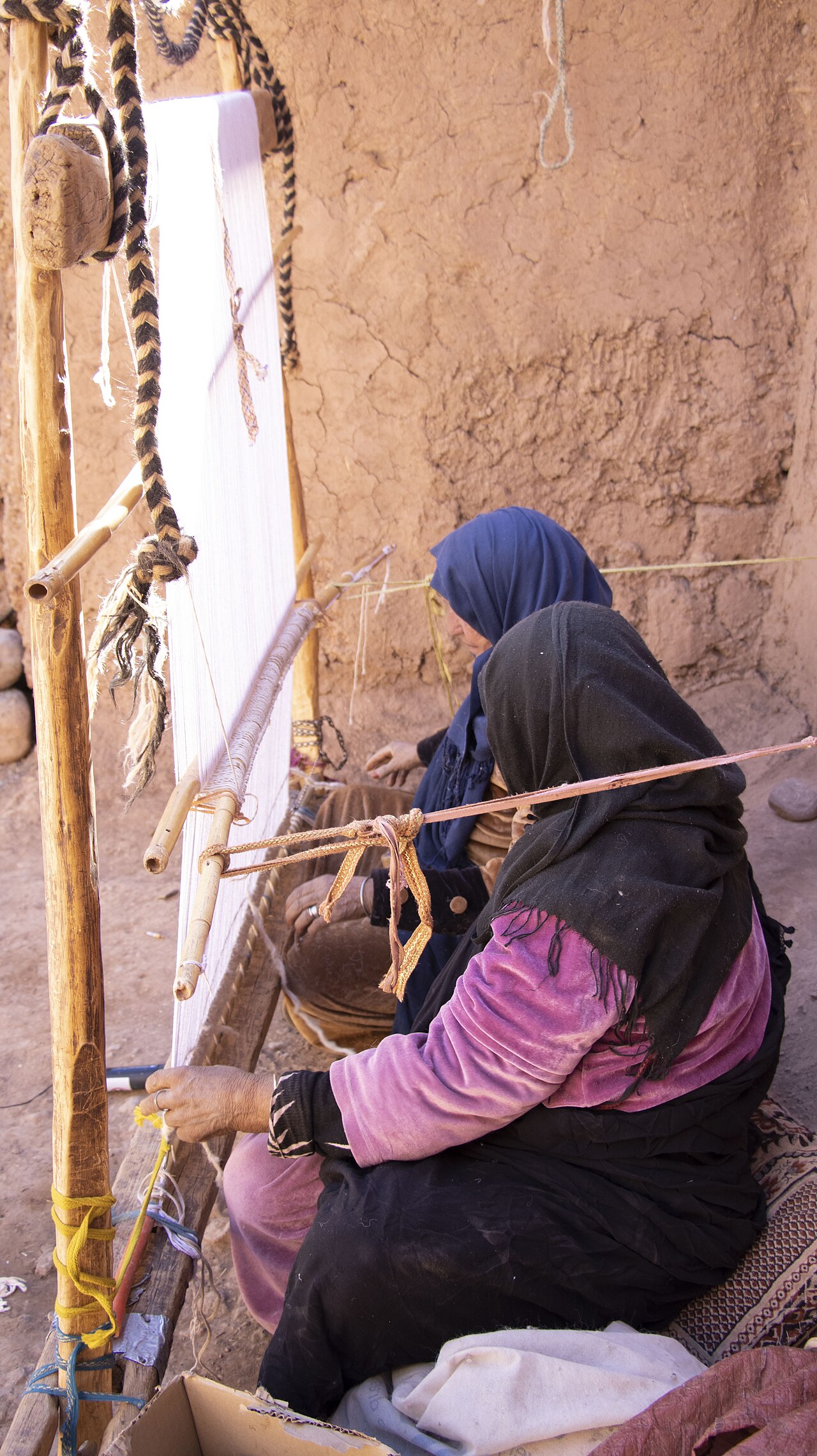

Moroccan carpets do not begin in a showroom. They begin with fibre, hands, memory and a loom that must be prepared before the first visible row appears. A useful weaving workshop lets you touch that process. A carpet sales stop may teach you something too—but it should not borrow the word “class” simply because tea appears.
The quick decision map
| If you want to… | Look for… | Watch out for… |
|---|---|---|
| Try weaving | A prepared loom, named weaver, supervised practice and feedback | Watching one knot, then moving into a sales pitch |
| Understand materials | Fibre, spinning, washing and dye explanation | “Natural” or “handmade” claimed from appearance alone |
| Make something small | A realistic sample, coaster or panel | Promises to complete a full rug in an afternoon |
| Learn regional styles | A precise community or region and careful comparison | Every Moroccan carpet called “Berber” with no detail |
| Buy fairly | Maker identity, material, dimensions, condition and price clarity | Guilt, invented symbolism or pressure to decide quickly |
Weaving is more than the knot
Before weaving begins, wool or other fibre may need cleaning, carding, spinning and dyeing. The loom is then warped: strong lengthwise threads are set under tension to create the structure. The weaver builds the surface with knots, flat weave, weft and careful packing.
A short class normally joins this long chain part-way through. The loom may already be dressed and the yarn prepared. That is perfectly honest when the teacher shows what happened earlier and lets you practise a meaningful stage.
What can you learn in a short workshop?
In two or three hours, a beginner may learn to:
- identify warp and weft;
- sit and work safely at the loom;
- make one or two basic knot or flat-weave structures;
- maintain tension and beat rows evenly;
- read a simple pattern or colour sequence;
- finish a small sample;
- recognise how errors are corrected.
You are unlikely to wash raw fleece, spin a full supply of yarn, dye it, warp a large loom and complete a carpet. A strong teacher makes the limitation interesting by connecting your small practice piece to the complete production story.
Place and people matter
Moroccan weaving varies between communities, regions and workshops. Fes offers strong access to craft networks and urban workshops. Chefchaouen and the Rif can connect weaving to northern rural traditions. The Atlas Mountains and southern centres such as Taznakht carry different material and design histories.
Avoid flattening this diversity into one decorative “tribal” story. Ask where the design and technique come from, whether the teacher belongs to that tradition and how knowledge is passed on.
Motif meanings are especially easy to exaggerate. A weaver’s own explanation is valuable. A seller’s universal chart claiming that every diamond means the same thing everywhere is not reliable evidence.
Dye, fibre and honest description
Find out whether the yarn is wool, cotton, mixed fibre or synthetic. The colours may also be natural, synthetic or mixed. Natural dyeing is a separate skill, and a muted palette alone does not prove it.
If dyeing is included, check which plant or mineral materials are used, how mordants are handled, whether protective equipment is needed and what stage participants complete. Watching a pot is not the same as preparing a dye bath and testing colour.
A fair workshop without buying pressure
The teacher’s identity and benefit should be visible. Does the weaver set the price? Is an organiser taking a commission? Is buying a carpet optional? These questions need not make the encounter awkward; clear hosts answer them calmly.
If you do want to buy, record the maker, materials, technique, size, age if claimed, repairs, price and shipping terms. Do not treat review ratings or a dramatic story as proof of origin.
The first five minutes at the loom
A thoughtful lesson starts before the first knot. The teacher can show you how the warp holds the structure, where the working edge sits and how tension changes the surface. You should know whether you are making a knot, passing a weft, beating a row or adding a decorative detail. “Now copy me” is easier once the movement has a name.
Ask to practise on a sample loom or a clearly focused section. Working on a large commission may be inappropriate because one your loose row can affect weeks of work. A separate practice strip protects the artisan’s piece and gives you permission to make a proper beginner’s mistake. That little crooked section is not failure; it is evidence that your hands were actually involved.
feedback should be visible. The weaver might adjust finger position, yarn tension, spacing or the way a row is packed. You then repeat the movement. If the teacher silently repairs everything after each attempt, you may leave with a neat sample but very little technique.
Reading a carpet without inventing a story
Look at structure before symbolism. Is the piece knotted, flatwoven or mixed? What is the warp made from? How dense is the surface? Where do colour changes happen? Are the edges and ends finished consistently? These observations are teachable even when a motif’s meaning is personal, regional or uncertain.
The weaver may explain a design through family memory, preference or local convention. Record that explanation with attribution: “The maker told us…” is stronger than turning one account into a universal rule for every Moroccan carpet. Avoid guides that present a tidy dictionary of symbols without naming the community or source.
Comfort, pace and translation
Weaving can involve long periods of low or fixed posture. Ask about chairs, cushions, breaks, work height and lighting. Learners with hand, back or vision needs may benefit from a larger sample, thicker yarn or an adjusted loom. Adaptation should preserve the learning goal rather than quietly removing all participant work.
If interpretation is needed, check whether the translator understands the technique. A warm conversation is valuable, but the words for warp, weft, knot and tension matter when you are trying to repeat the movement correctly.
Children can enjoy colour planning and simple passes on a safe sample loom. They should not be expected to sit through a long sales presentation or handle dye materials without clear supervision.
Questions worth asking
- Who teaches, and where did they learn?
- Which regional technique or structure will I practise?
- Is the loom already warped?
- What will I make, and can I take it home?
- Are yarns hand-spun, machine-spun, naturally dyed or synthetic?
- How many learners share one loom and teacher?
- How is the practitioner paid?
- Is purchasing optional?
- What are the seating, access and child-safety arrangements?
- May I photograph the teacher and the work?
Build a richer craft route
Start with the Fes learning guide and compare weaving in Fes with leather craft, zellige and pottery or wider craft workshops. For a different geographic context, explore Chefchaouen, Tetouan or the Atlas Mountains.
Return to the Morocco learning hub to build a route around craft, food or language.
Enquire with the useful details
Tell GoLearnTo your dates, base, group size, experience level, access needs and whether you want weaving, dyeing, fibre preparation or maker-led interpretation. If you hope to take home a sample, say so. We will help check for real loom time before you arrive.
What we checked
Sources behind the local details
We used these sources for local history, geography and cultural context. Opening times, access and programmes can change, so confirm current details with the venue or host. Sources checked on 14 August 2026.