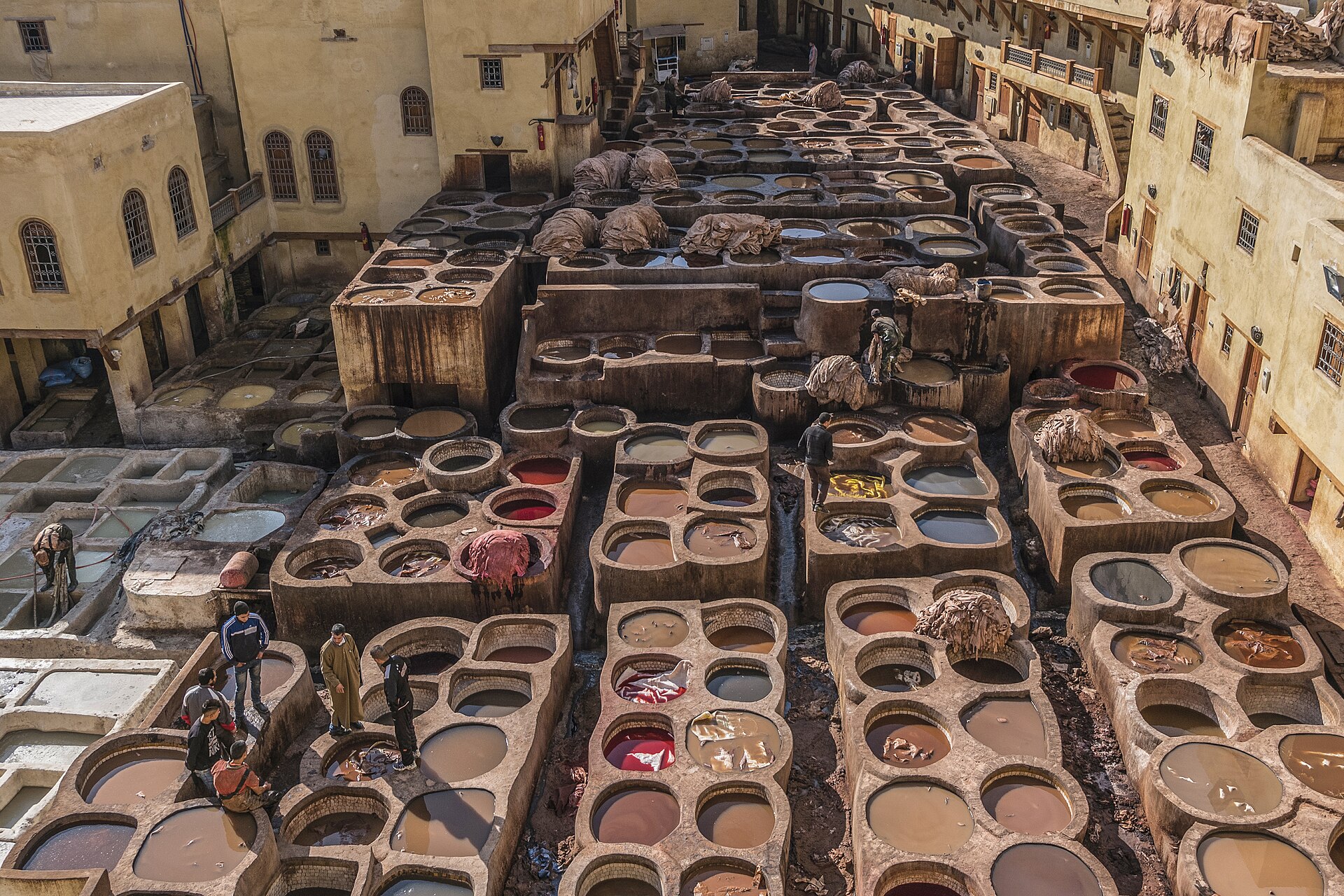
A tannery viewpoint explains part of Fes leather production; it does not teach leather craft. A genuine workshop gives you a supervised role in selecting, marking, cutting, punching, stitching or finishing a small object.
Three products that are often confused
| Product |
Main activity |
Learning depth |
| Tannery interpretation |
Observe and hear an explanation |
Context |
| Leather shopping |
Compare finished goods |
Retail decision |
| Leather workshop |
Make through defined stages |
Practical learning |
Bookbinding overlaps with leather craft when a cover is measured, cut, tooled or attached to a text block. Ask whether the session teaches binding structure or only cover decoration.
A credible beginner sequence
A small-object class might include choosing a wallet, bracelet or journal format. Transferring a pattern; cutting or receiving safely prepared pieces; marking and punching stitch holes; hand stitching; and applying an appropriate finish.
Not every learner needs to perform every hazardous stage. The provider should say when the artisan takes over and why. Safety boundaries increase trust when they are explicit.
Material provenance and controls
“Natural leather” is not enough information. Ask about material origin, dye or polish, ventilation and skin-contact precautions. Cutting blades, punches, hammers and adhesives require tool instruction and an organised work surface.
The famous tanneries are important city entities. However, their visibility should not be used to make unsupported claims about the provenance of material in a particular workshop.
What we found in Fes
Fes Leather Workshop currently describes a three-to-six-hour workflow with material selection, tracing, cutting, dye or polish, punching, hand stitching and a object you take home. That is a strong public sequence, but the named artisan, legal operator details, material controls and exact teaching ratio remain not confirmed.
Questions before you enquire
- What exact object will be made?
- Which steps do you complete personally?
- Who is the artisan teacher?
- What is the maximum group size and teaching ratio?
- How are hides sourced and which dyes, finishes or adhesives are used?
- What blade, ventilation and protective-equipment controls apply?
- Is bookbinding structural or only decorative?
- Is the venue accessible, insured and explicitly alcohol-free?
- What are the current date, price and cancellation terms?
Continue through craft workshops in Fes, compare metal engraving, or understand the difference between the workshop and leather tanning.
What we checked
Sources behind the local details
We used these sources for local history, geography and cultural context. Opening times, access and programmes can change, so confirm current details with the venue or host. Sources checked on 14 August 2026.
- UNESCO World Heritage Centre
- Moroccan National Tourist Office