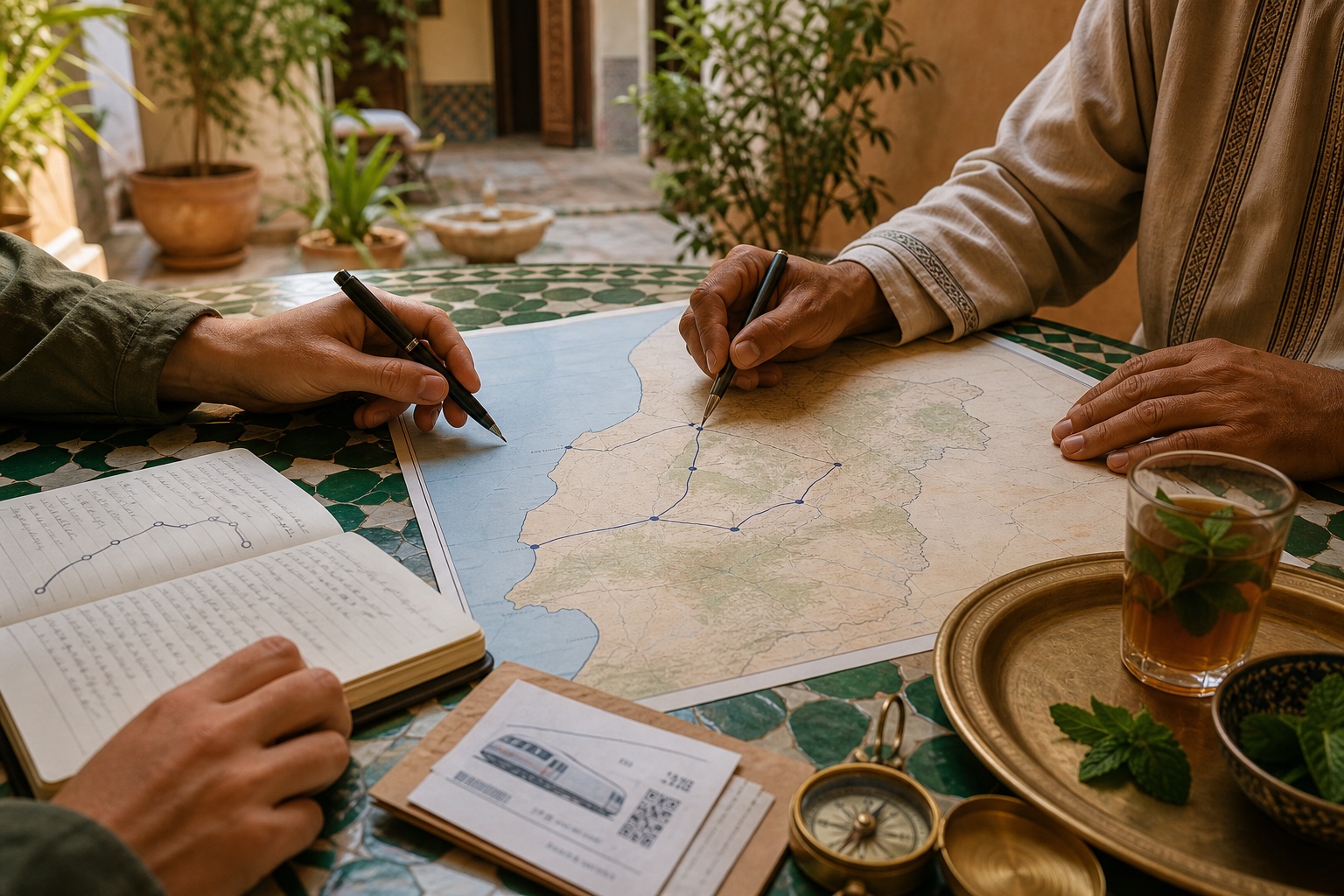
The best Morocco learning itinerary is not the one with the most pins. It is the one that protects enough time to practise, receive feedback and understand why the skill belongs in that place. These 7-, 10- and 14-day patterns are planning tools, not live packages. Confirm transport, teachers, dates and conditions before booking.
How to use the routes
Every pattern includes four kinds of day:
- Arrival and orientation: settle, locate the venue and adjust.
- Learning block: active teaching plus feedback.
- Context block: guided interpretation, market, landscape or museum that strengthens the skill.
- Transfer or rest: movement and recovery stated honestly.
Do not convert every context block into another class. Learning needs space to settle. Mint tea is not wasted time, especially when your hands have spent three hours arguing with clay.
Seven days: one strong base
For a first trip, choose one main base and a nearby contrast only if it fits naturally.
| Day | Pattern |
|---|---|
| 1 | Arrive, settle and confirm the teaching venue |
| 2 | First practical lesson |
| 3 | Context visit or guided interpretation |
| 4 | Second lesson with correction and progression |
| 5 | Independent practice, compatible secondary skill or rest |
| 6 | Final session, review or take-home method |
| 7 | Depart without scheduling a class against the airport clock |
Strong seven-day bases include Fes for craft/language, Marrakech for multi-skill access, Essaouira for creative and Atlantic combinations, Taghazout for repeated surf coaching, or Imlil for mountain learning with suitable conditions.
Route 1: Fes and Chefchaouen
Best for: material craft, Arabic/Darija, food, weaving and visual practice.
Fes deserves the deeper learning block. Its cluster supports structured Arabic, cooking and the clearest distinctions among pottery, zellige, leather, weaving and artisan interpretation. Chefchaouen adds Rif context, painting, photography, cooking, language and carefully bounded rural pottery/weaving leads.
Seven days
- Four or five nights in Fes with two related learning sessions
- Transfer to Chefchaouen
- Two nights for one selected skill or careful visual/cultural interpretation
Ten days
Add a third Fes session, a finishing/collection buffer and more rest around the transfer.
Fourteen days
Add Tetouan for Arabic, Andalusian-facing cultural context and a broader craft vocabulary. Do not add it merely because the map line passes nearby.
Cut first: an unrelated desert excursion. It consumes route time without strengthening this northern craft-and-language theme.
Route 2: Marrakech and Imlil
Best for: cooking, Darija, calligraphy, zellige, weaving, photography and High Atlas field learning.
Use Marrakech for the practical urban skill. Then move to Imlil for interpreted walking, mountain decisions and household cooking where current host evidence supports it.
Seven days
- Four nights Marrakech: one main workshop plus one compatible session
- Road transfer and three nights around Imlil
- One appropriately graded mountain or village-context learning day
Ten days
Protect two practical sessions in Marrakech and two mountain/context blocks. Keep a weather fallback.
Fourteen days
Add a slower Atlas stay or Aït Benhaddou only if earthen architecture becomes a genuine second theme.
Cut first: a dawn-to-night day trip squeezed between two classes. The Atlas is not a decorative interval.
Route 3: Essaouira, Taghazout and Agadir
Best for: surf, wind sports, Gnawa, photography, painting, food and argan context.
Choose one primary Atlantic skill. Essaouira is strongest for a multi-skill coast with music and visual practice. Taghazout is strongest for repeated surf progression. Agadir adds cooking, Tamazight context, argan, craft and broader Souss-Massa access.
Seven days
Use one base only: Essaouira for creative/wind combinations or Taghazout for surf coaching.
Ten days
Combine two bases. Protect repeated water sessions in one; use the other for a contrasting cultural or culinary skill.
Fourteen days
Add Agadir when a specific teacher or argan/cooking/craft proposition justifies it. Three hotel changes for three beaches is not topical authority. It is laundry.
Cut first: duplicate beginner surf sessions sold under different town names without a progression plan.
Route 4: Rabat, Casablanca, Tangier and Tetouan
Best for: Darija/formal Arabic, urban history, architecture, cooking, calligraphy and northern craft.
This route can use the rail-connected city corridor more effectively than a mountain/desert circuit. It still needs current timetable checks and careful course calendars.
Seven days
Choose Rabat plus one second city. Rabat works for structured language and capital/historic-city interpretation. Casablanca adds modern architecture, food and Darija. Tangier or Tetouan adds the northern language, music, visual and craft context.
Ten days
Use two main bases and one short context stop. Protect language contact hours rather than changing cities daily.
Fourteen days
Three bases become possible when each changes the learning goal. Keep Fes outside this route unless the theme expands into material craft and the extra journey earns its place.
Cut first: a city visited only for a checklist landmark.
Route 5: Ouarzazate, Aït Benhaddou and Merzouga
Best for: film-production interpretation, earthen architecture, photography, oasis food and astronomy.
This route contains the largest transfer cost. It also offers a coherent southern learning theme when each stop has a clear job.
Seven days
Choose Ouarzazate and Aït Benhaddou only. Add Merzouga another time unless the road and observation schedule are the main purpose.
Ten days
Add Merzouga with a protected astronomy/desert-field block and weather/moon fallback. State the travel days.
Fourteen days
Slow the same route rather than adding more pins. Include recovery, repeat photography/architecture observation and a second night-sky opportunity.
Cut first: any “workshop” that is actually a quick retail, studio or camp stop with no named teacher or learner task.
Audit your itinerary before paying
Score each route from 0 to 2 on:
| Test | 0 | 1 | 2 |
|---|---|---|---|
| Active teaching | unclear | one bounded attempt | repeated protected practice |
| Feedback | none | general help | named correction and progression |
| Transfer load | dominates | manageable | clearly subordinate to learning |
| Teacher continuity | unknown | partly known | named and confirmed |
| Conditions and fallback | absent | generic | skill/date-specific |
| Access and suitability | assumed | partly described | practical chain confirmed |
| Cultural consent/benefit | invisible | stated broadly | direct evidence available |
A low score does not mean the route is a bad holiday. It means it is not yet a strong learning itinerary.
Use the travel-time guide and when-to-learn guide, then enquire about the exact teacher and dates. GoLearnTo does not operate these routes or promise their availability. We help turn the theme into a better set of questions.
Turn a route into your own learning plan
Write one primary outcome for the whole trip. Then give each base a job. A place may provide formal teaching, practice in context, a contrasting method or necessary rest. If it provides none of these, it may be sightseeing—which is perfectly fine, provided the itinerary labels it honestly.
Next, mark every session as confirmed, requested or idea only. Do not allow three idea-only workshops to support a non-refundable route. Confirm the hardest-to-replace teacher or activity first, then arrange the transport around it.
Finally, keep one unscheduled half-day after demanding activities or long transfers. That space absorbs weather, fatigue and Moroccan timing without sacrificing the trip’s main lesson. It may also become the afternoon when a teacher explains the small detail you remember for years.
Five routes appear here because Morocco supports several coherent learning journeys. They are not a challenge to complete all five. One route learned well will always beat a national treasure hunt with homework.
Evidence
Selected references
Official and institutional references used for place, heritage or practical context. Commercial operators and marketplaces are kept in our private research ledger rather than promoted here. Reviewed 15 August 2026.