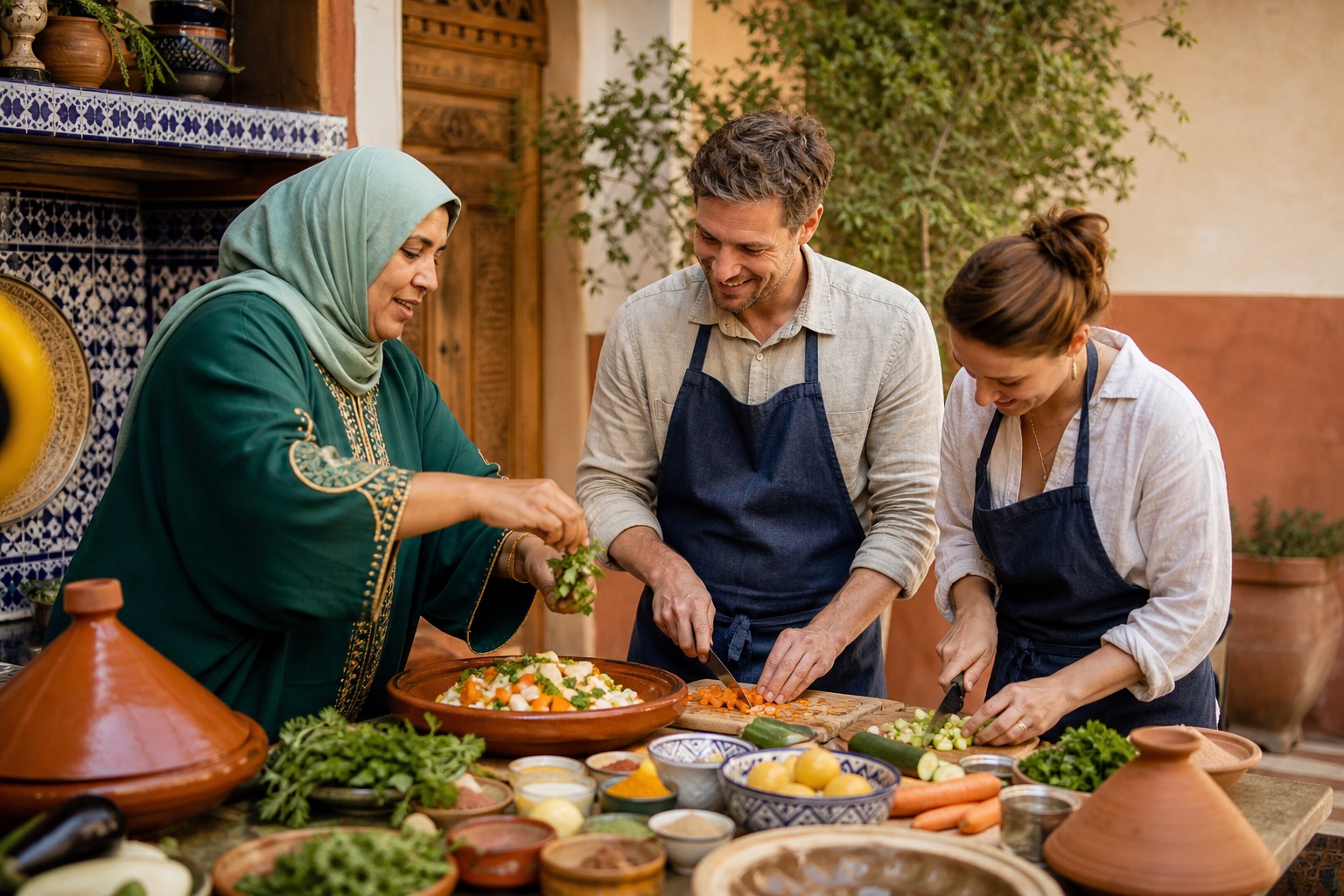
Marrakech gives you several serious choices: cook, practise Darija, build Arabic letterforms, assemble zellige, shape clay or work at a loom. Choose the page that names your task, teaching time and feedback—not the listing with the longest string of cultural adjectives.
Marrakech has atmosphere for days. For a real lesson, check how many hours you will spend cooking, speaking, cutting, shaping or weaving—and how much individual feedback you receive.
Choose the learning outcome first
| If you want to… |
Start with |
Check that you will… |
| Reproduce a Moroccan dish |
Cooking |
Individual preparation, feedback and recipes |
| Speak respectfully in everyday situations |
Arabic and Darija |
Guided speaking, pronunciation feedback and a defined vocabulary set |
| Understand Arabic letter construction |
Calligraphy |
Named script, repeated strokes and teacher feedback |
| Work with geometric surface design |
Zellige |
Drawing, assembly and safe boundaries around cutting |
| Shape or decorate a clay object |
Pottery |
Exact hands-on stages plus drying, firing and collection plan |
| Understand rug structure through making |
Weaving |
Loom time, tension feedback and artisan attribution |
| Improve a visual story, not collect portraits |
Photography |
Assignments, critique, consent and image-use rules |
| Read the Medina beyond a sightseeing script |
Heritage interpretation |
A focused route, named sources and a knowledgeable interpreter |
Marrakech suits these skills for different reasons. Food begins in its markets and kitchens; Darija belongs in daily conversation; craft needs a studio, proper tools and patient hands. When no suitable host is listed, use the page checklist to compare local offers.
Medina, Guéliz, Targa and studio Marrakech are different learning days
The Medina gives immediate context for architecture, trade, calligraphy, food and craft. However, dense lanes and visitor traffic can turn a session into a rushed demonstration. Guéliz and dedicated studios may offer more room, quieter feedback and easier equipment handling. Targa is a separate transfer from the historic centre and deserves a morning or half-day block. Do not squeeze it between two Medina stops.
Sidi Ghanem and other workshop districts can be relevant when the teacher and process are there. They should not be marketed as “hidden local Marrakech” merely because they sit outside the old city. Name the venue, explain the transfer and protect the actual teaching time.
Agafay, Ourika, Imlil and the Atlas Mountains are onward destinations, not Marrakech neighbourhoods. A provider combining them with the city must separate transfer, touring and meals from genuine instruction.
How to recognise a real workshop
A real lesson should let you watch, try and get corrected. Ask what you will do yourself, how much practice time you receive and whether the teacher helps you improve a second attempt.
Something useful to keep makes the lesson travel home with you: a recipe, phrase sheet, corrected lettering sample, image edit or pattern notes. A souvenir is pleasant; a method you can repeat is better.
Craft has more than one clock
Zellige, pottery, calligraphy and weaving are often sold under one “artisan workshop” label, yet their time constraints are very different. Wet clay may need drying and firing after you leave. Zellige cutting can involve sharp tools, so beginners may assemble prepared pieces. A mini weaving sample can fit one session when the loom and warp are ready. Ink work needs drying, repetition and feedback.
Ask what is already prepared. Then ask what you perform yourself, what is completed later. Then ask how collection or delivery works. Two hours in a studio may include far less than two hours of active practice.
Photography needs consent, not just good light
Marrakech offers colour, geometry, motion and changing light, but people are not visual props. A responsible workshop should explain when permission is required and how the teacher handles refusal. It should also clarify compensation and any editorial or commercial use. Homes, worship, work and children require especially careful boundaries.
The strongest teaching format includes an assignment, a selection or edit and specific feedback. A guided walk with camera settings can be useful; a portrait-collection route without consent governance is not a GoLearnTo recommendation.
Language and heritage should change how you participate
A short Darija lesson can reasonably help with greetings, numbers, courtesy, basic transactions and pronunciation. It should not be sold as fluency. A good heritage walk uses streets and buildings to explain water, trade, home life, craft and conservation. You should leave with a story, not a list of dates.
Language and interpretation can improve how you move through the city. Learn how to greet, ask before photographing and enter a working space. Most importantly, recognise where a public route ends and someone’s workplace or home begins.
What to verify before you enquire
- The current teacher or practitioner and their role in the session
- The exact hands-on stages, individual feedback and active teaching time
- Group size, starting level, teaching language and accessibility
- Tool, heat, food, allergy, kiln, blade and ventilation controls where relevant
- Subject consent and image-use rules for photography
- Material origin, artisan attribution and how the practitioner benefits
- The city venue, meeting point and transfer time
- Explicit alcohol-free ingredients, inclusions, setting and optional activities
- Current availability, price, cancellation terms and insurance
The possible hosts on this page are not paid placements and have not confirmed live availability with GoLearnTo. Read the open questions before enquiring, especially the teacher, meeting place, hands-on time, food or safety controls and current price. A provider may correct its facts, but cannot buy a favourable review.
Build a coherent Marrakech learning route
Begin with the Marrakech craft map if materials interest you, compare Moroccan cooking with Darija if participation matters most, or pair photography with Medina interpretation when your goal is careful observation. For terminology, use the guides to the Medina, zellige, kiln firing and carpet weaving.
Enquire with the useful details
Tell GoLearnTo what you want to practise, your dates, starting level, preferred language and any access or dietary needs. An enquiry lets you check the details before deciding. It does not reserve a place.
What we checked
Sources behind the local details
We used these sources for local history, geography and cultural context. Opening times, access and programmes can change, so confirm current details with the venue or host. Sources checked on 14 August 2026.
- UNESCO World Heritage Centre
- UK Government travel advice