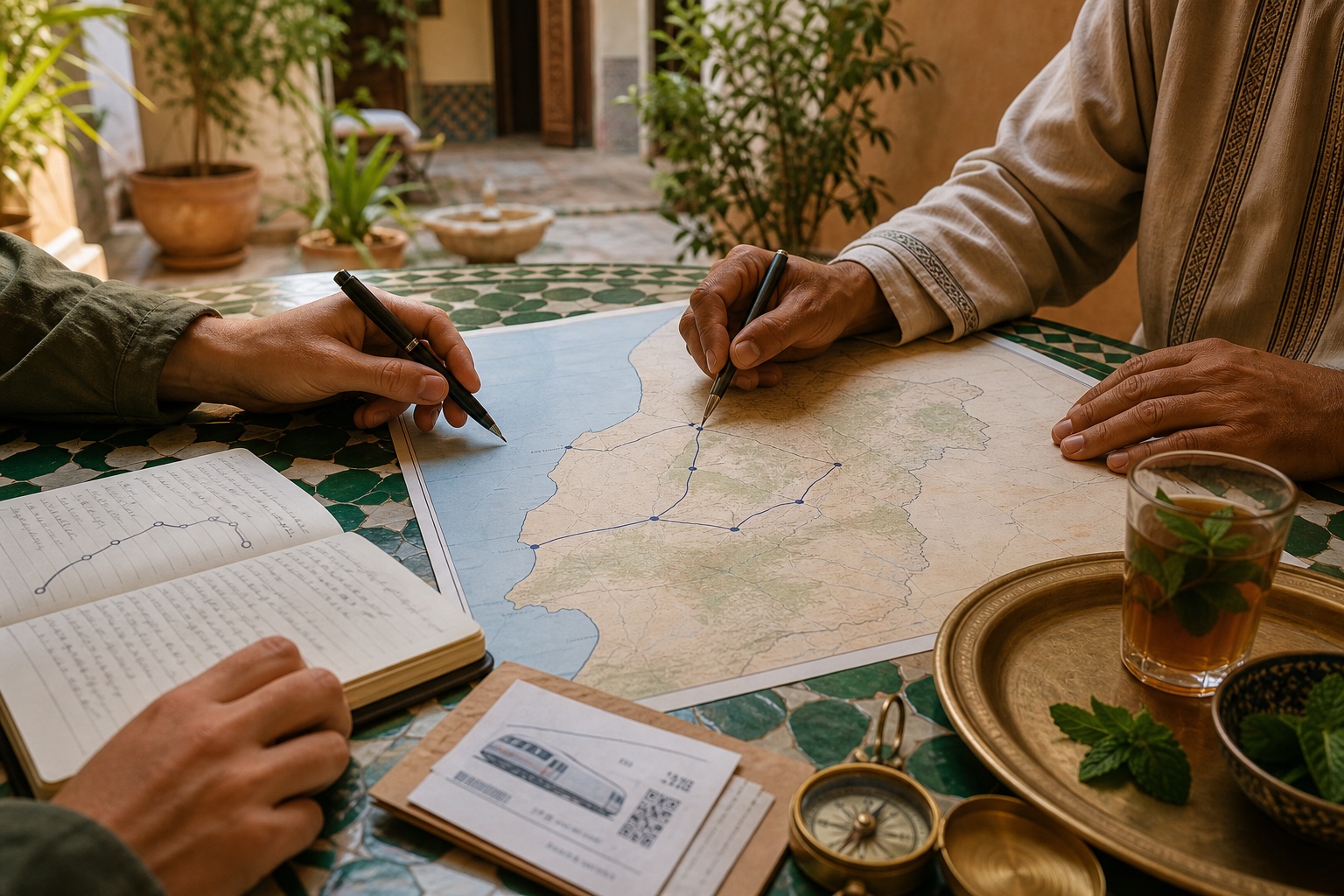
Morocco route planning looks simple until a “short transfer” eats breakfast, checkout, half a day and your first lesson. For a learning holiday, measure door-to-door time and lost teaching blocks, not only kilometres. Rail connects useful city corridors; mountains, Atlantic villages and southern routes add road decisions.
Map distance is the beginning, not the answer
A transfer contains more than the moving vehicle:
- Packing and checkout
- Reaching the station, airport or pickup
- Waiting and boarding
- The journey itself
- Breaks, changes and delays
- Reaching the new accommodation
- Checking in and finding the teaching venue
- Recovering enough to pay attention
This does not mean transfers are bad. A second place can add a genuinely different material tradition, landscape or language context. The useful question is whether the change is worth the time it removes from practice.
Where rail can simplify the route
ONCF provides the current search and booking source for Morocco’s train network. Rail can support combinations among cities on the connected corridor, including Marrakech, Casablanca, Rabat, Tangier and Fes depending on the live service searched.
Use the current ONCF portal rather than a blog’s old timetable. Schedules can change for operational reasons and religious periods. ONCF published a special Marrakech–Fes plan for Ramadan 2026; that proves the need to recheck, not a timetable to reuse forever.
Before committing to a lesson after arrival, confirm:
- Exact station and service
- Change requirements
- Luggage and equipment
- Station-to-venue transfer
- Accessibility assistance
- Delay tolerance in the provider’s terms
Do not schedule your most expensive practical class immediately after a long route. The train may be comfortable. Your attention still needs to arrive.
Where road transfer becomes part of the product
Imlil, Taghazout, Aït Benhaddou, Merzouga and many rural workshops require road travel from an airport, rail city or another base. The transport may be provider-arranged, private, shared or independent.
Ask for:
- Pickup point and responsible operator
- Vehicle type, seat and luggage limits
- Approximate door-to-door range with a date
- Planned rest and meal stops
- Child-seat or mobility arrangements
- Surfboard, craft-output or large-bag handling
- Weather or road fallback
- What happens after an activity finishes late
A marketplace may label an experience “Marrakech” because pickup starts there while teaching happens in a mountain home. That can be an excellent day. It should still disclose where your lesson takes place and how much of the advertised duration is transport.
Choose the airport for the whole route
Morocco has an airport network serving multiple cities and regions. ONDA publishes airport locations and operational information. A close-looking airport may reduce the first transfer, but flight time and fare are not the only variables.
Compare:
| Question | Why it matters |
|---|---|
| Where is the first teaching base? | The nearest airport to a country route may not be nearest to your first class |
| What time does the flight arrive? | Late arrival can remove the next morning’s useful attention |
| Is onward transport confirmed? | Airport existence does not create a reliable final transfer |
| Does the airport provide needed assistance? | Assistance must be requested and does not automatically continue beyond the terminal |
| Are you carrying equipment or a finished object? | Size, fragility and airline rules may change the sensible route |
ONDA lists assistance at named airports, and Casablanca airport advises passengers needing reduced-mobility support to communicate requirements in advance. This is useful arrival evidence. It does not prove the taxi, street, riad or workshop is accessible. Follow the full Venue Access Chain.
One base, two bases or a circuit?
One base
Best when teacher continuity and repeated practice matter. It reduces packing and lets you return for finishing, critique or a second attempt.
Two bases
Best when the second place adds a clearly different learning context. Marrakech plus Imlil can join urban food or craft with mountain interpretation. Fes plus Chefchaouen can contrast deeper material processes with Rif-context visual or rural craft learning.
Longer circuit
Best when travel itself supports a coherent field theme and the schedule protects learning blocks. A southern route can connect Ouarzazate, Aït Benhaddou and Merzouga, but road time must be shown honestly. It should not be described as three full learning days when much of the time is movement.
Calculate the Learning Route Cost
For each move, record:
- Door-to-door estimate with source and check date.
- Lost teaching block: none, morning, afternoon or full day.
- Recovery cost: how demanding is the route for your group?
- Continuity cost: does changing place break a multi-session course?
- Equipment cost: boards, tools, luggage or finished work.
- Access cost: assistance, steps, seating and vehicle entry.
- Fallback: what happens if the connection fails?
Then compare the second place with another day in the first. If it changes the skill, landscape, practitioner or cultural context enough, keep it. If it adds only a famous photograph, enjoy the photograph online and protect the lesson.
Recheck the moving parts
Transport details are among the fastest facts to age. Recheck ONCF, ONDA, the airline, provider pickup and official travel advice near departure. Obtain written meeting instructions and a reachable contact.
Use the learning itinerary guide for route patterns. It provides structure, not live booking. Morocco is generous with places worth seeing. Your calendar is less generous. Plan accordingly.
A transfer can consume two lessons
Suppose a class ends at midday and your next booking starts the following morning. The distance may look manageable. Now add packing, the station or pickup, waiting, the actual journey, traffic, arrival, finding the accommodation and locating tomorrow’s venue. The transfer has used the afternoon and weakened the next morning.
This matters most when the skill needs repetition. Two classes in one base often create more learning than two impressive cities with one rushed class each. If the second place adds a genuinely different method or environment, keep it. If it only adds another hotel key, reconsider.
Route handoff checklist
For every change of base, record:
- Exact departure and arrival points
- Published timetable or agreed pickup window
- Ticket, luggage and equipment rules
- Last-mile transport to the accommodation
- Last-mile transport to the learning venue
- Named contact if a connection fails
- Arrival after dark and accessibility implications
- Time needed before the next active session
Surfboards, finished craft objects, walking equipment, children and mobility aids can change an easy-looking journey. Confirm the real luggage and vehicle arrangement.
Keep nearby places honest
A provider profile may sit under a city while the actual lesson happens outside it. That can be useful: Rif pottery may involve a rural day from Chefchaouen, while High Atlas learning may use Marrakech as an arrival gateway. The page should state the boundary, transfer and teaching site clearly.
“Marrakech experience” is not enough if the learner spends four hours on the road. Ask where the teacher meets you, where the skill is practised and which part of the day is transport. Morocco’s landscapes deserve time; they should not be hidden inside the word “nearby.”
Evidence
Selected references
Official and institutional references used for place, heritage or practical context. Commercial operators and marketplaces are kept in our private research ledger rather than promoted here. Reviewed 15 August 2026.