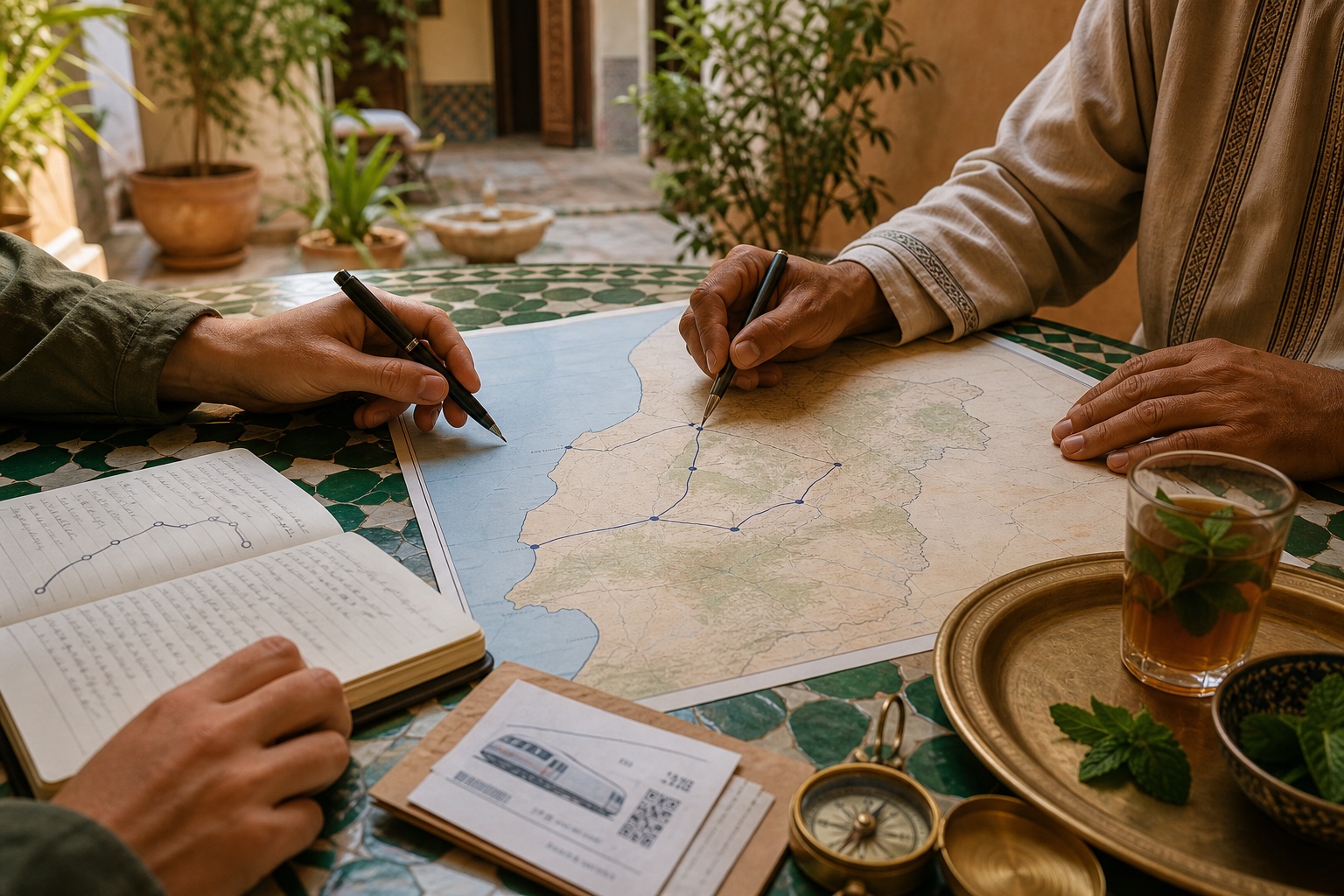
For your first learning holiday in Morocco, choose one skill you care about, one place that gives it context and enough time to practise twice. Add a second skill only when it fits the same base or route. A full camera roll is lovely; a method you can still use six months later is better.
Begin with the sentence you want to say afterwards
Finish this sentence:
“After this trip, I want to be able to…”
Useful endings are specific. “Cook a tagine with better heat and layering” works. “Understand every Moroccan spice” is too broad. “Use greetings, numbers and courtesy phrases in Darija” is realistic for a short introduction. “Become fluent in Arabic by Friday” will make your teacher smile politely.
Your outcome does not need to be grand. It needs to help you compare programmes.
| Weak goal | Better first-trip goal |
|---|---|
| Experience Moroccan culture | Learn one cooking, craft, language or field method with context |
| Do pottery | Complete named clay, painting or mosaic stages with feedback |
| Learn Arabic | Practise a defined Darija or formal-Arabic outcome |
| Go surfing | Receive level-matched instruction and a progression plan |
| Visit the Atlas | Learn route, landscape or mountain decisions with a qualified guide |
Choose one main skill
A first trip does not need to audition every category on GoLearnTo. Pick a primary skill and, if the schedule allows, one compatible extra.
Good pairings share a place, pace or learning rhythm:
- Cooking plus Darija in Fes, Rabat or Marrakech
- Surf coaching plus sensible yoga practice in Taghazout
- Zellige plus broader craft interpretation in Fes or Tetouan
- Photography plus urban history in Tangier or Casablanca
- Walking plus household cooking around Imlil
The second activity should complement the first, not steal the practice block. A sunrise hike, full cooking day, evening language class and dawn surf lesson may look heroic in a spreadsheet. Your knees may file a complaint.
Choose the place from the skill
Morocco’s famous cities overlap, but they are not interchangeable classrooms.
Fes offers the deepest combined context for material craft, Fassi food and structured Arabic study. Marrakech has the broadest short-workshop choice and easier multi-skill planning. Essaouira joins Atlantic conditions with Gnawa, photography, food and visual practice. Taghazout is more tightly built around surf progression. Imlil gives High Atlas walking and household context that cannot be replicated in a city showroom.
Use the Morocco learning map to compare all 17 places. Do not choose a base only because the flight was cheap or a marketplace had 700 cards there. Arrival convenience matters; it does not teach.
Protect a Learning Time Budget
Count six kinds of time:
- Transfer time between airports, stations, hotels and bases.
- Orientation time to find the venue and understand the setting.
- Active time when you handle, speak, cook, move or decide.
- Feedback time when somebody explains what changed.
- Second-attempt time when learning becomes visible.
- Rest time so the next session is not performed by your exhausted ghost.
A four-hour listing may include transport, welcome tea, shopping, demonstration, lunch and photographs. Ask how many minutes the learner controls the process. The answer need not be huge, but it should be honest.
For seven days, one main base is often enough. Add a second place only when it changes the learning context meaningfully. See our route guide before turning the week into a luggage relay.
Choose the right teaching format
A tour helps you see. Interpretation helps you understand. A demonstration shows how someone else does it. A lesson gives you instruction and correction. A course protects repeated contact hours. A retreat is a package shape; it may contain serious teaching, light sessions or mostly accommodation.
None is automatically superior. A tannery viewpoint can provide valuable interpretation without being a leather class. A two-hour tile session can teach pattern assembly without covering clay preparation, glazing and firing. Trouble begins when the description promises the whole craft while your hands touch only the brochure.
Use our format guide before comparing products with different promises.
Check the person and the current details
Before you treat a listing as real, ask:
- Who is the assigned teacher, artisan, coach or guide?
- What will I do, and for how long?
- Will I receive correction and try again?
- Which language will be used?
- What is the maximum group size and starting level?
- Where exactly does teaching happen?
- What materials, equipment, meals and transfers are included?
- What safety, accessibility, dietary or age limits apply?
- Is the entire programme alcohol-free?
- What are the current date, price, deposit and cancellation terms?
A review score cannot answer most of these questions. A named provider might not know the exact teacher until the schedule closes. That uncertainty is manageable when it is stated clearly.
Send an enquiry that can be answered
Include:
- Your possible dates and number of learners
- The skill and outcome you want
- Your current level
- Preferred teaching language
- Children’s ages, if relevant
- Mobility, sensory, dietary, medical or equipment needs
- Whether you need accommodation or transport
- Your alcohol-free requirement
Then ask the provider to confirm the current teacher, venue, schedule, active learning stages, price and terms in writing.
An enquiry is not a booking. It is the moment we turn a beautiful idea into questions that a real host can answer. Start with the complete guide library, then choose depth over panic. Morocco will still be here after lunch.
A realistic first-trip pattern
Imagine you have seven nights and want to learn Moroccan cooking. A weak plan adds a class wherever the tour happens to stop. A stronger plan chooses one base—perhaps Marrakech, Fes or Tetouan—and protects a real teaching block.
The first day is for arrival and orientation. The second can introduce the market, ingredients and kitchen. The third leaves space for the main class and a calm return. Later days may add a related skill, such as Darija, bread, spice interpretation or ceramics. A second city only earns its place if it adds a different learning context.
This pattern works for other skills too. A beginner surfer needs repeated water time and recovery, not a new coast every morning. A language learner benefits from several lessons and daily practice. A craft learner may need drying, firing or finishing time that a two-hour visit cannot provide.
Mistakes that make a first learning holiday harder
- Choosing five unrelated activities because each one looks “authentic”
- Counting an excursion’s full duration as teaching time
- Booking transport before the teacher or date is confirmed
- Assuming a famous craft district guarantees hands-on access
- Hiding dietary, access or confidence needs until arrival
- Treating the cheapest headline as the cheapest complete experience
- Expecting one short lesson to produce mastery
Your first learning holiday does not need to be perfect. It needs one honest outcome, enough time to practise and a host who can answer direct questions. If you return able to repeat a recipe, use ten Darija phrases, recognise a zellige stage or stand more confidently on a board, the trip has already earned its name.
Evidence
Selected references
Official and institutional references used for place, heritage or practical context. Commercial operators and marketplaces are kept in our private research ledger rather than promoted here. Reviewed 15 August 2026.