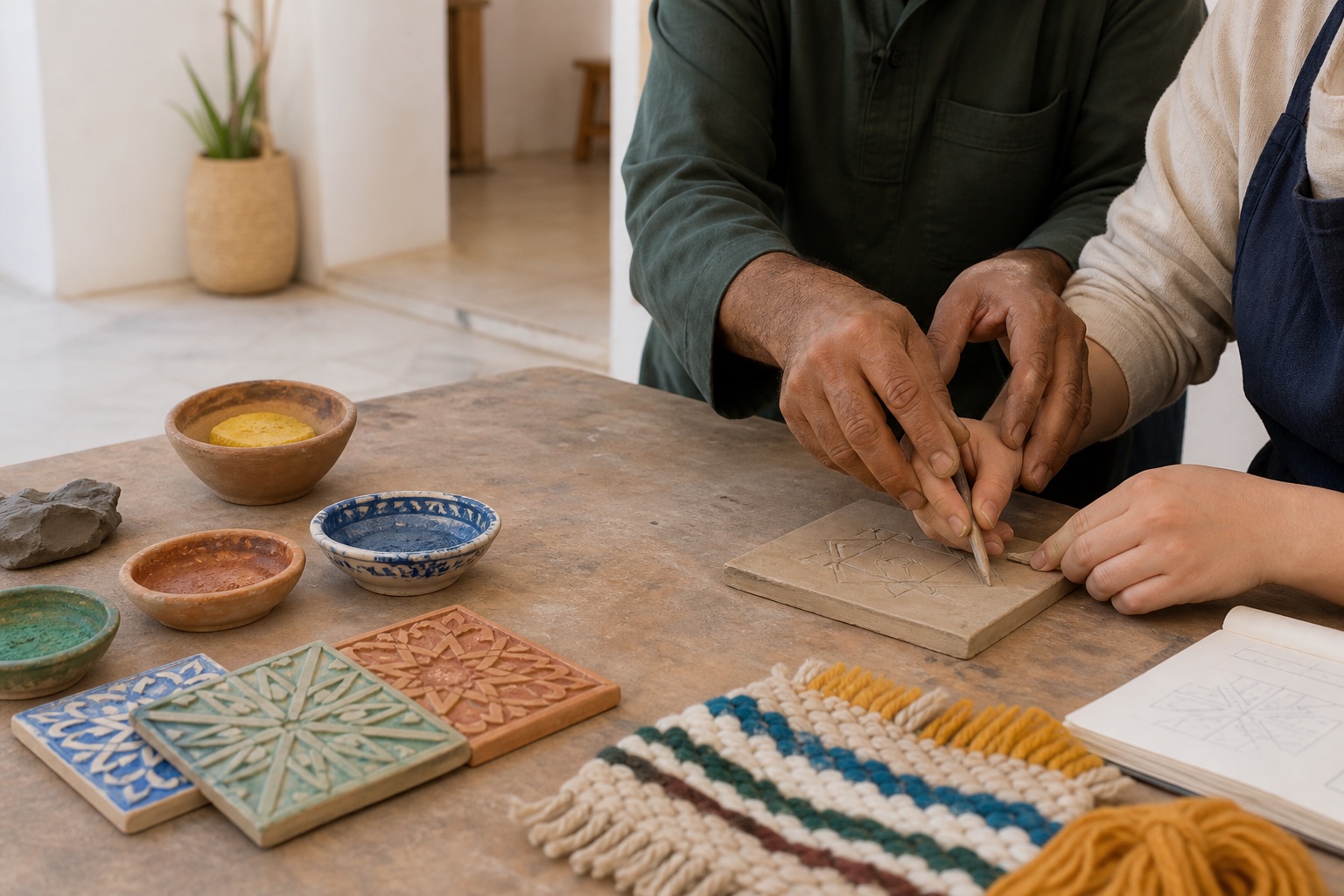
A tour helps you see. Interpretation helps you understand. A demonstration shows how a practitioner works. A class asks you to practise and receive correction. None is automatically “better”; each should make a different promise. Choose by what you want to do afterwards, not by the most impressive label.
The Format Ladder at a glance
| Format | Learner role | Reasonable outcome |
|---|---|---|
| Visit or observation | Watch and notice | Recognise a place, object or process |
| Tasting | Compare guided samples | Describe differences with context |
| Tour | Follow a route | Understand sites and sequence |
| Interpretation | Connect evidence and meaning | Explain why a place or practice matters |
| Demonstration | Watch a practitioner perform | Describe stages and decisions |
| Workshop | Attempt a bounded task | Complete one or more practical stages |
| Lesson | Practise with correction | Improve a defined action |
| Coaching | Repeat and progress | Build level-specific performance |
| Course | Follow sequenced contact hours | Develop broader capability |
| Retreat | Stay-based package | Depends entirely on teaching inside it |
The ladder describes increasing learner control and repetition. It is not an accreditation. A carefully guided heritage tour may be more valuable than a rushed “masterclass.”
Observation and tasting
Watching a zellige cutter, hearing a guembri performance or seeing a communal oven can provide real insight. A food tasting can teach comparison when somebody explains ingredients, region, preparation and context.
The boundary is simple: observation does not prove you can perform the technique. Tasting does not become cooking because a recipe appears at the end.
Good observation pages say:
- Who interprets the process
- What the visitor can see
- What access or photography rules apply
- How the practitioner or site benefits
- What is not included
This is especially important where visitor participation could interrupt skilled work, create safety risks or cross cultural boundaries.
Demonstration and interpretation
A demonstration answers how. Interpretation answers what it means and why it belongs here.
An artisan may demonstrate leather tooling. A qualified guide may explain tannery history, urban water, labour and trade. A teacher might do both, but the page should not blend the roles invisibly.
Interpretation becomes stronger when it uses evidence, observation prompts and comparison. It becomes weaker when it recites dates while steering the group towards a shop. Commercial stops are not automatically wrong; they should be disclosed.
For living heritage, interpretation also needs consent and humility. A guide cannot grant access to every household, sacred practice or practitioner story.
Workshop and lesson
A workshop gives the learner a bounded practical role. A lesson adds a clearer instructional goal and correction.
A useful beginner workshop might:
- Explain the object and stages.
- Demonstrate one safe task.
- Let the learner attempt it.
- Correct pressure, order, proportion or technique.
- Allow a second attempt.
- Finish with a small output or repeatable method.
The session does not need to cover the whole craft. In fact, claims to teach a multi-stage tradition in ninety minutes deserve serious questions. Our workshop guide shows what to verify.
Coaching, course and retreat
Coaching is progression-led. Surf coaching, for example, should group learners by level, observe performance and adjust the next attempt. Guiding an experienced surfer to a suitable break is different from teaching a beginner.
Courses protect repeated contact hours. Language, art and more technical skills benefit from sequence, teacher continuity, assignments and review. Ask how many hours are active teaching rather than social or excursion time.
Retreat describes a stay, not a teaching standard. It may include accommodation, meals, transport, classes, free time and wellbeing sessions. Compare the timetable discipline by discipline. “Surf and yoga” should show real surf instruction and real yoga teaching—not one serious activity plus stretching near a cushion.
Apply the ladder to Moroccan examples
Zellige
- Visit: view a workshop or finished architecture.
- Demonstration: observe cutting or assembly.
- Workshop: arrange pre-cut tesserae or try a supervised stage.
- Lesson/course: receive structured practice in pattern, cutting or assembly over sufficient time.
Cooking
- Tasting: compare dishes or ingredients.
- Tour: explore a market with context.
- Demonstration: watch a cook prepare the meal.
- Class: make defined stages, control heat/seasoning and receive correction.
Language
- Cultural activity: learn a few phrases with explanation.
- Lesson: practise a defined language target with correction.
- Course: follow placement, syllabus and repeated contact hours.
Mountains
- Walk: follow a route.
- Guided interpretation: learn landscape, ecology or community context.
- Skills instruction: practise navigation, movement or technical decisions with a qualified person.
Five questions reveal the format
Ask:
- What will I personally do?
- For how many active minutes?
- Who observes and corrects me?
- Will I repeat the task?
- What outcome is realistic?
Then add the operational questions: exact place, date, level, group size, language, safety, access, inclusions and cancellation.
Choose the rung that suits your goal. You do not need a course when you want informed appreciation. You do need more than a tour when the page promises a skill. Morocco has room for both—provided we call them by their proper names.
Test the verbs in the description
The verbs reveal the format faster than the photographs. See, visit, hear and taste usually describe observation. Watch and explain suggest demonstration or interpretation. Practise, make, repeat and receive feedback indicate active learning. Progress, assess and coach belong to longer or more structured teaching.
Marketing copy often mixes every verb together. Ask which actions apply to each learner. A group may watch one person knead dough, while everybody later plates a dish. That can be enjoyable, but it is not the same as each learner preparing the recipe.
Examples of honest names
| What actually happens | Clearer name |
|---|---|
| Guided tannery viewpoint with process explanation | Fes tannery interpretation visit |
| Artisan cuts zellige while visitors ask questions | Zellige demonstration and studio visit |
| Learners assemble a small design from prepared pieces | Beginner mosaic assembly workshop |
| Each learner cooks, receives correction and repeats a technique | Hands-on Moroccan cooking class |
| Teacher leads repeated Darija lessons with level progression | Darija language course |
| Coach assesses conditions and gives water feedback | Surf coaching session |
The clearer name is not less exciting. It gives the visitor the freedom to choose.
When a tour is the responsible choice
Hands-on access is not always appropriate. A dangerous tool, sacred context, fragile heritage site or practitioner’s working deadline may limit participation. Interpretation can still create excellent learning when the guide explains process, vocabulary, history and current practice with care.
Do not pressure a community or craftsperson to turn every activity into visitor participation. The goal is meaningful understanding, not collecting fingerprints on every tradition. A well-designed tour can outperform a fake workshop; a real class can outperform both when practice is the goal.
Ask for the format in one sentence: “During the session, each learner will…” If the provider can complete that sentence clearly, you are already closer to the truth.
Evidence
Selected references
Official and institutional references used for place, heritage or practical context. Commercial operators and marketplaces are kept in our private research ledger rather than promoted here. Reviewed 15 August 2026.