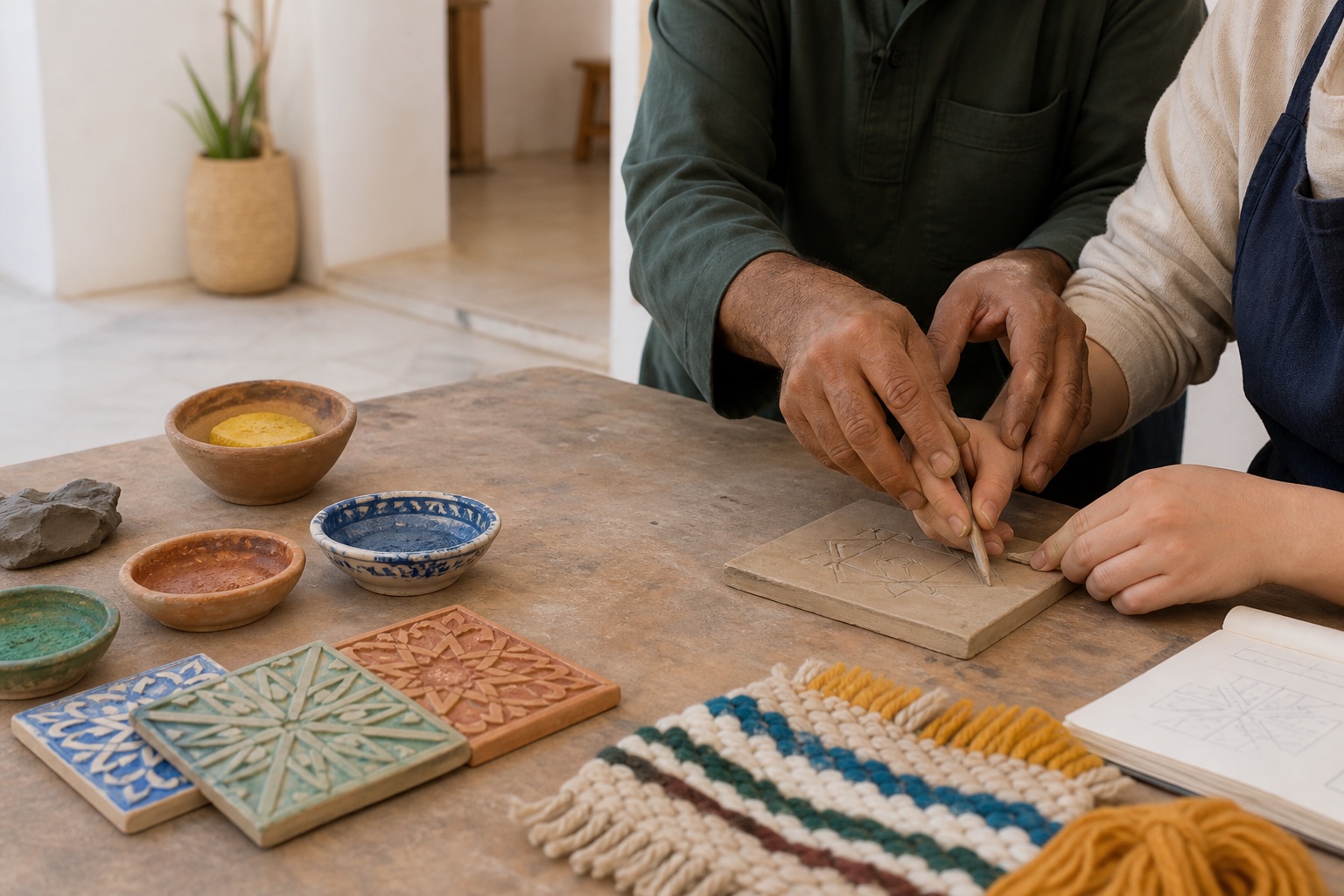
To choose a worthwhile workshop in Morocco, ask which stage your hands will perform, who will teach it, what correction you receive and how the practitioner benefits. A showroom, demonstration and lesson can each be valuable. The problem is not observation. The problem is selling observation as mastery.
Start with the learner’s hands
The craft name is not enough. “Zellige workshop” might mean cutting tile, assembling pre-cut pieces, painting a square tile or watching an artisan. “Carpet weaving” might mean setting a loom, tying a few knots, hearing a design explanation or shopping. “Cooking class” can range from participant-led preparation to watching lunch arrive.
Ask for verbs:
- Will I cut, shape, mix, weave, assemble, season or speak?
- Which parts are prepared before I arrive?
- Which decisions belong to me?
- What will the teacher demonstrate first?
- How will they correct my attempt?
- Will I try again?
Prepared materials are not cheating. A two-hour visitor workshop cannot reproduce a multi-day drying, firing or dyeing chain. Honest preparation creates a realistic lesson. Hidden preparation creates a misleading promise.
Identify the person and their role
Morocco workshops may involve several people:
| Role | Useful contribution | Does not automatically prove |
|---|---|---|
| Artisan or practitioner | Deep process knowledge and skilled demonstration | Teaching method, visitor language or current availability |
| Teacher | Structured explanation, practice and correction | Community authority over every cultural claim |
| Guide or interpreter | Place, history and process context | Hands-on craft instruction |
| Translator | Communication between learner and practitioner | Teaching or craft expertise |
| Sales host | Welcome, product explanation and purchasing help | Independent advice or practical training |
One person can hold several roles. The page should say which. “Local expert” is too foggy to evaluate.
Ask for the assigned practitioner’s name, current role, teaching language and whether they will personally lead your date. A famous founder on the About page does not guarantee that person will be in the room.
Look for correction and a second attempt
Participation is not automatically instruction. You can enjoy pressing one tile into place or stirring a tagine without learning a repeatable method.
A stronger sequence is:
- The practitioner explains or demonstrates a bounded task.
- The learner attempts it.
- The practitioner observes and corrects something specific.
- The learner changes the second attempt.
- The session closes with a method, output or next-practice note.
For beginners, correction can be gentle and simple: hand position, pressure, sequence, proportion, heat or pronunciation. It does not need to feel like an exam. It does need to exist if the product is sold as a lesson.
Check materials, tools and finishing
Every craft has an operational tail that glossy cards often hide.
Zellige and pottery
Ask whether you cut, paint, shape or assemble; which tools are used; what safety equipment is provided; and whether firing, backing, drying or collection happens later. Read the zellige guide.
Weaving and textiles
Ask whether the loom is already set, which knot or weaving action you practise, how fibres and dyes are described, and who owns the design. Read the weaving guide.
Leather
Tannery interpretation and leather making are not the same experience. Ask about the material supplied, chemical/tool exposure, ventilation and the exact making or finishing stage. Read the Fes leather guide.
Cooking
Ask which stages are participant-led, how ingredients and allergens are handled, whether knives and heat suit the group, and what method or recipe remains. Read the tagine guide.
Ask who consented and who benefits
UNESCO’s ethical principles for living heritage place communities, groups and practitioners at the centre. They emphasise transparent collaboration, dialogue, informed consent and respect for material and moral interests.
For a visitor workshop, that becomes practical:
- Did the practitioner agree to teach and be photographed?
- Is the cultural or family knowledge appropriate to share in this format?
- How is the practitioner paid?
- Who sets the description and corrects errors?
- Does retail pressure replace teaching?
- Can the practitioner limit access, images or reproduction?
Do not demand a performance because money changed hands. A workshop is still a relationship between people, not access to every technique, story or photograph.
Understand the venue
A studio, cooperative, school, museum, home, shop and rural village create different learning conditions.
A home session needs household consent, exact meeting and dietary/access information. A shop needs a clear separation between learning and selling. A rural workshop needs transport and practitioner-benefit detail. A museum may offer excellent interpretation without practical making. A cooperative label should be sourced rather than assumed from décor or marketing.
Check the full path:
- Exact address or teaching area
- Transfer and meeting point
- Entrance, stairs, seating, toilet and workshop position
- Ventilation, dust, heat and tool controls
- Photography rules
- Finishing, collection or shipping
- Cancellation and alternative if the practitioner is unavailable
Use the Workshop Proof Ladder
| Level | Evidence visible | Editorial status |
|---|---|---|
| 1 | Marketplace or social listing | Research lead only |
| 2 | Direct provider page or contact | Identity and proposition established |
| 3 | Named teacher and exact venue | Operational responsibility clearer |
| 4 | Learner stages, active time and correction | Teaching proposition supported |
| 5 | Materials, safety, access, output and terms | Practical comparison possible |
| 6 | Practitioner consent, attribution and benefit | Cultural/ethical basis supported |
| 7 | Current date reconfirmed | Ready for the specific enquiry, subject to suitability |
Popularity does not move a provider automatically up this ladder. Evidence does.
Questions to send before you pay
Ask the provider to confirm:
- Assigned teacher and teaching language
- Exact venue and meeting point
- Total duration and active participant time
- Demonstration, first attempt, correction and second attempt
- Materials prepared in advance
- Tool, heat, dust, food or chemical controls
- Group size, age and starting-level fit
- Accessibility and toilet/seating details
- Take-home output and finishing arrangements
- Current price, inclusions and cancellation
- Alcohol-free ingredients, venue and programme
- Photography consent and practitioner compensation
GoLearnTo provider profiles show what is known and what remains on HOLD. That is not less helpful than instant booking. It is the difference between an attractive label and a learning experience you can actually understand.
Read the reply, not just the listing
A serious provider does not need perfect marketing English. The reply should still answer the substance. Look for a named person, clear learner actions, realistic timing and honest limits. “You will discover the secrets of our ancestors” may sound lovely, but it does not tell you whether you touch the tool.
Strong replies often use simple verbs: cut, shape, mix, knead, repeat, correct, fire, finish or take home. Weak replies repeat the title, avoid the teacher question or promise every stage inside an impossible time.
Match the workshop length to the process
Some outcomes fit a short session. You can practise a calligraphic stroke, mix a spice blend, assemble pre-cut mosaic pieces or cook one structured menu. Other processes contain waiting, drying, firing, preparation or years of embodied skill.
A short zellige session cannot recreate the full craft chain. A tannery visit is not automatically leatherworking. Watching dough enter a communal oven does not make the oven a private cooking classroom. Honest providers narrow the learner outcome instead of pretending time has become elastic.
Ask which stages happen before and after your visit. If another person finishes the object, that is acceptable when disclosed. You are buying a defined learning role—not ownership of everyone’s labour because your name appears on the booking.
Evidence
Selected references
Official and institutional references used for place, heritage or practical context. Commercial operators and marketplaces are kept in our private research ledger rather than promoted here. Reviewed 15 August 2026.