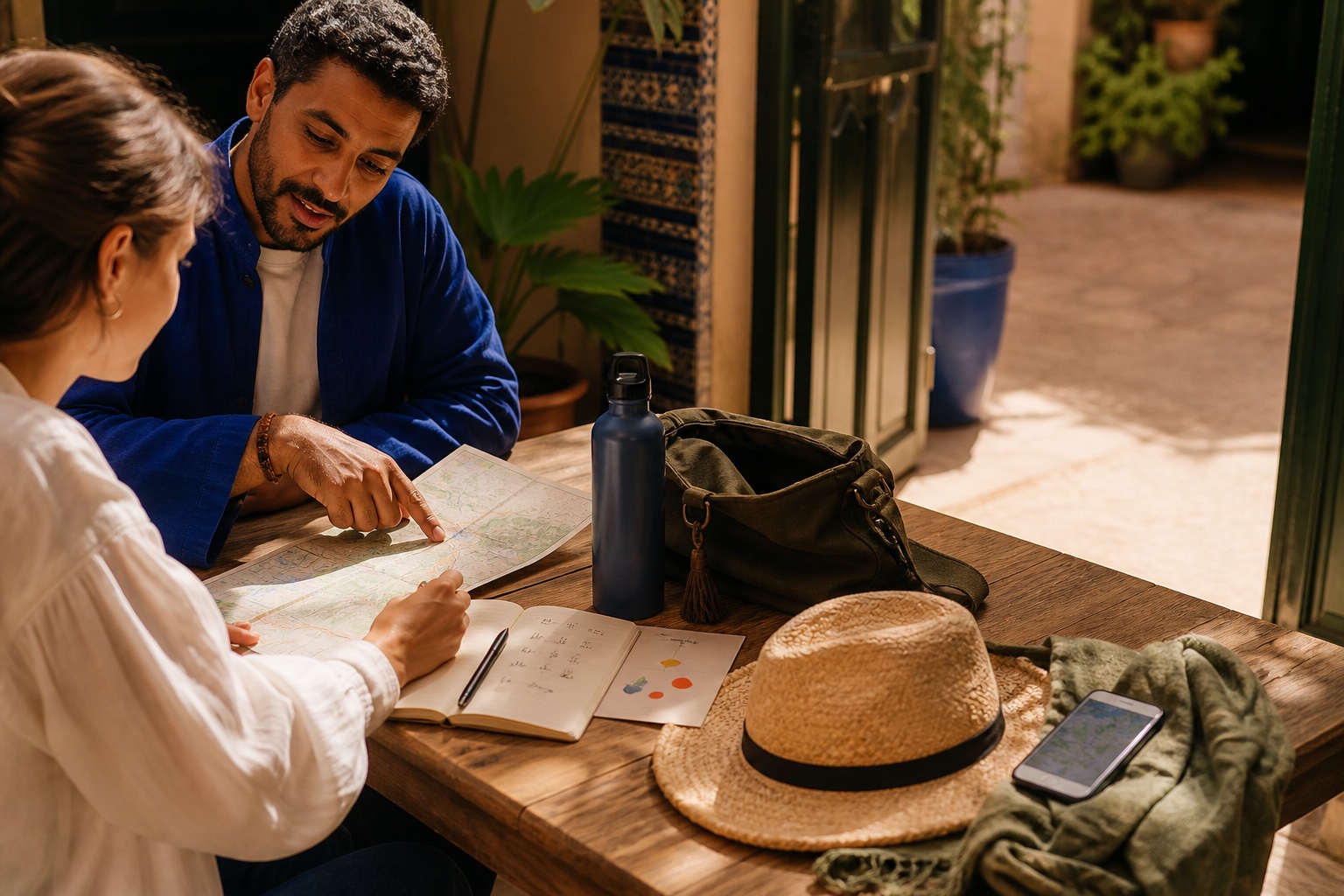
For everyday conversation in Morocco, many visitors begin with Moroccan Darija. Choose Modern Standard Arabic for more formal reading or academic goals. Amazigh languages need their own place and teacher evidence. French and Spanish may be useful in particular settings, but no language belongs automatically to every Moroccan you meet.
Morocco does not speak with one voice
Official Moroccan visitor information identifies Arabic and Amazigh as official languages. It also describes widespread French use and Spanish context in parts of Morocco. That tells us Morocco is multilingual. It does not tell us which language one person prefers or speaks.
Good language learning begins by asking:
- What do I want to do with the language?
- Where will I use it?
- Do I want speaking, literacy or both?
- How many contact hours can I protect?
- Which variety does the teacher actually teach?
“Arabic in Morocco” is a category. It is not yet a syllabus.
Moroccan Darija for everyday interaction
Darija is Morocco’s spoken Arabic variety. A short visitor course can reasonably focus on greetings, courtesy, numbers, directions, food, basic transactions and pronunciation.
Useful beginner teaching includes:
- Listening before repeating
- Sound and rhythm correction
- Small phrase-building patterns
- Role practice rather than memorised performance
- A defined vocabulary set
- Respectful real-world practice prepared with the teacher
A market is not automatically a classroom. A teacher can prepare a bounded task, explain etiquette and review what happened. Sending a beginner out to collect conversations from working people is not the same thing.
Choose Darija when your main goal is everyday spoken interaction during travel or a longer stay.
Modern Standard Arabic serves another purpose
Modern Standard Arabic is used across formal writing, news, education and wider Arabic-language communication. It differs from everyday Moroccan Darija.
Choose it when your goal includes reading, formal grammar, media, academic work or a foundation that travels beyond Morocco. A school may offer both; ask whether the course combines them, separates them or assumes prior knowledge.
For a short trip, splitting limited contact hours between two varieties can reduce depth. That may still be worthwhile when the teacher explains the relationship clearly.
Amazigh languages and Tamazight terminology
“Amazigh” can refer to people, identity and cultural context. Amazigh languages include distinct varieties. “Tamazight” can be used broadly and for a particular variety depending on context. Tifinagh is the writing system taught and promoted in official Amazigh-language work.
For a learning experience, ask:
- Which language variety is taught?
- Is the course spoken, written or cultural introduction?
- What is the teacher’s relationship to the language and place?
- Is Tifinagh included?
- Is the outcome a few phrases, structured study or interpretation?
Do not attach “Berber language” to a mountain product as decoration. Use current names, respect the teacher’s terminology and let the place evidence lead. Agadir and Souss-Massa may surface different language context from the Rif or Middle Atlas.
French and Spanish context
French appears in education, business, tourism and daily life in many settings. Spanish has stronger historical and regional context in parts of northern Morocco and elsewhere. Individual language ability varies by generation, education, location and person.
Choose French or Spanish learning when it is genuinely part of your goal and a qualified course exists. Do not treat them only as convenient substitutes for learning a Moroccan language. Equally, do not shame a traveller for using the language that enables a respectful conversation.
The Language Goal Router
| Your goal | Language route to investigate | What to verify |
|---|---|---|
| Everyday travel conversation | Moroccan Darija | Teacher, speaking practice, correction and regional context |
| Formal reading and wider Arabic foundation | Modern Standard Arabic | Placement, literacy level, grammar and contact hours |
| Amazigh language and writing | Named Amazigh variety / Tifinagh | Exact variety, teacher, place and realistic outcome |
| Academic/professional French | French course | Level, curriculum, teacher and assessment |
| Northern Spanish context | Spanish where a current course supports it | Course identity, level and why the place strengthens learning |
The router narrows the enquiry. It does not decide the course for you.
Compare the actual course
Ask every school or teacher for:
- Language variety and target outcome
- Placement process
- Assigned teacher
- Contact hours, days and breaks
- Maximum class size
- Teaching language
- Correction and homework/practice
- Materials and literacy assumptions
- City-use tasks and consent boundaries
- Accessibility and online/alternative formats
- Current dates, price and cancellation
A cultural excursion can reinforce learning. It should not quietly replace paid contact hours unless the course explains its teaching purpose.
Good beginner outcomes are modest and useful
After a short course, you might greet someone, introduce yourself, ask a simple question, recognise numbers, read selected script or understand the difference between Darija and formal Arabic. That is progress.
Fluency takes time, exposure and continued practice. Morocco provides a rich language environment, but the city cannot correct your pronunciation. A teacher can.
Use the Morocco Arabic and Darija hub to compare Fes, Rabat, Tetouan, Marrakech, Tangier and other qualified places. Choose the language goal first. Then let Morocco answer in more than one voice.
Ask what the teacher will actually teach
“Arabic course” can refer to Modern Standard Arabic, Moroccan Darija, Quranic or classical study, literacy, conversation, grammar or a mixture. Request the timetable by variety and skill. If script appears, ask whether learners read and write or only recognise selected forms.
For Tamazight, ask which regional variety and community context the programme uses. Do not treat the national umbrella term as proof that the same spoken form works everywhere. For French or Spanish, ask whether the goal is formal language, local conversation, academic study or professional use.
Use the city outside class carefully
Morocco gives language learners abundant exposure, but residents are not unpaid practice equipment. Begin with greetings, consent and patience. Buy something because you need it, not because a shopkeeper has been assigned a surprise role in your lesson plan.
A good teacher can set small field tasks: recognise numbers, order a simple item, ask a direction, listen for a phrase or record what you did not understand. The next class then turns the experience into feedback.
Compare language programmes
| Question | Why it matters |
|---|---|
| Which variety is taught? | Matches the course to your real goal |
| How many live teaching hours? | Separates tuition from excursions |
| Private, group or mixed? | Changes pace, interaction and cost |
| What is the entry level? | Prevents false beginner/intermediate labels |
| Is script included? | Clarifies literacy expectations |
| Who teaches? | Makes qualification and continuity checkable |
| How is progress assessed? | Shows whether feedback is structured |
| What field practice is supported? | Connects class language to place respectfully |
Combine language with another skill
Cooking, craft, music or market learning can reinforce useful vocabulary when the teacher and activity host coordinate. The combination should not reduce both subjects to a few decorative words. Ask which phrases are prepared beforehand and how they will be reviewed.
In Fes or Tetouan, Darija may support artisan and food interactions. In Essaouira, language can help explain Gnawa or coastal context. The language lesson remains a lesson; the cultural activity remains a real encounter. The bridge between them is deliberate preparation, not simply placing two items on the same itinerary.
Evidence
Selected references
Official and institutional references used for place, heritage or practical context. Commercial operators and marketplaces are kept in our private research ledger rather than promoted here. Reviewed 15 August 2026.