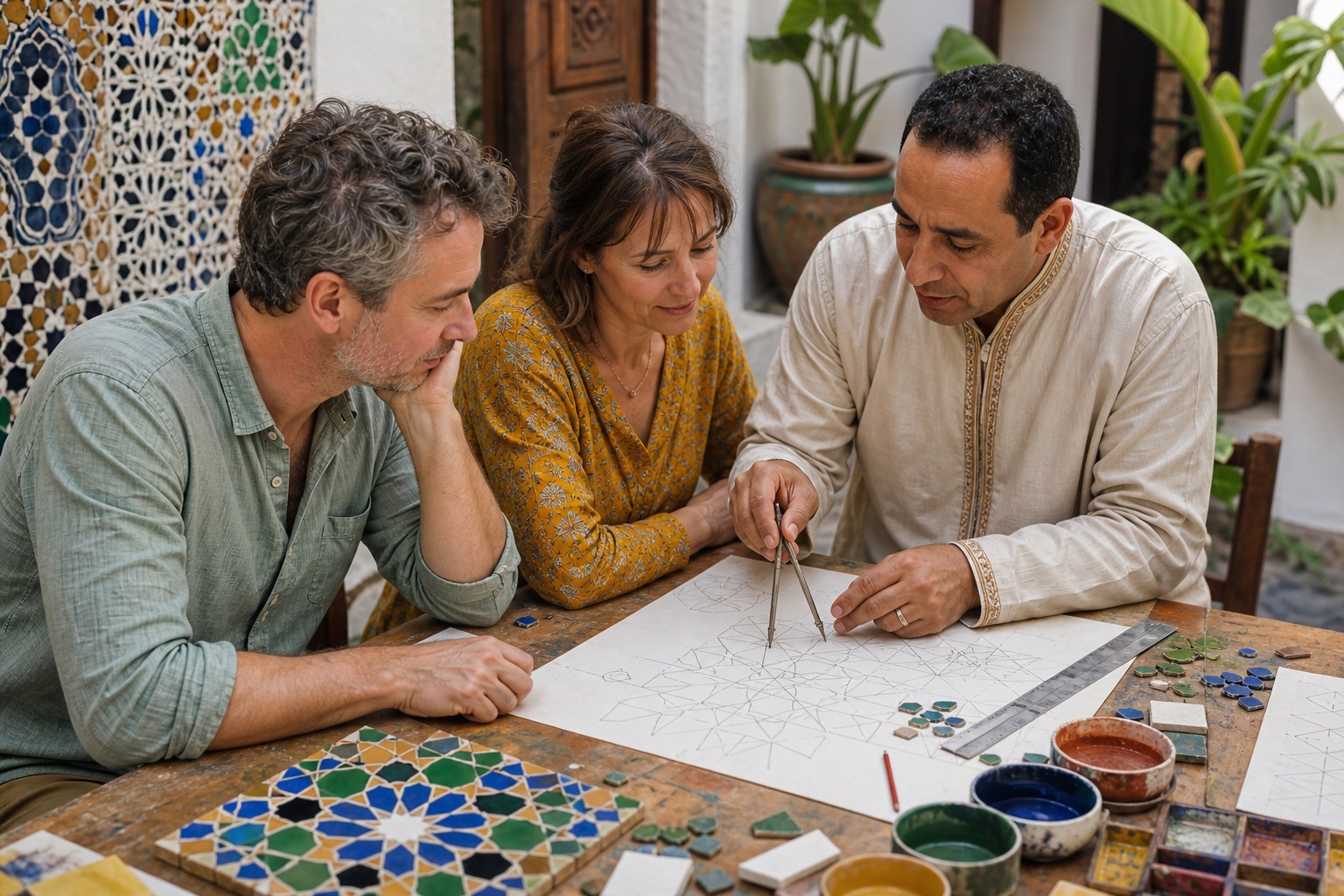
Each Tetouan skill needs its own practitioner, materials and teaching plan. It offers three different learning environments. Read the UNESCO-listed Medina, practise a material process in a working studio or study Arabic and art over time. The useful trip begins by choosing the environment that matches your goal.
Come to Tetouan for Arabic, artisan studios, zellige, pottery, weaving, leather, cooking, painting, photography and city interpretation. Start with the skill, then choose a teacher and setting that fit it properly.
Choose your Tetouan learning route
| If you want to… |
Start with |
What to compare |
| Study Arabic over days or weeks |
Arabic and Darija |
Variety, level, contact hours and named teacher |
| Meet a maker in a working studio |
Artisan studio visits |
Consent, participant role and direct local benefit |
| Understand cut-tile geometry |
Zellige |
Learner-facing stages, tools and finishing |
| Work directly with clay |
Pottery |
Making time, feedback, drying and firing |
| Learn a textile process |
Weaving and embroidery |
Technique, practitioner and corrected action |
| Tool or bind leather |
Leather craft |
Personal tasks, material and tool controls |
| Form letters with a qalam |
Calligraphy |
Script, stroke sequence and feedback |
| Cook rather than watch |
Cooking |
Personal tasks, kitchen consent and allergens |
| Make a visual study |
Painting |
Named artist, medium and critique |
| Build and review an image sequence |
Photography |
Assignment, selection, critique and consent |
| Read the city through its history |
History and museums |
Route grounded in reliable records, current access and guide identity |
| Compare Medina and Ensanche on foot |
Urban walking |
Exact route, surfaces, stairs and permissions |
| Learn food culture through tasting |
Food interpretation |
Named supplier, route, foods and safety controls |
Photography and food interpretation belong in Tetouan, even when no suitable host appears yet. Use the skill pages to understand the format and send your dates if you want help finding a current teacher.
Medina, workshop or school?
The Medina of Tetouan is a place: its street pattern and buildings support historical and urban interpretation. Dar Sanaa is a public cultural institution, but admission does not promise access to apprentices or a hands-on lesson. INBA proves the city has a serious visual culture, not that it offers drop-in tourist classes. Direct workshop catalogues and language-school sites describe another kind of offer; check the current teacher, session and availability.
A thoughtful history route moves between the street and the museum. Notice a feature in the Medina or Ensanche, then compare it with an object at Bab El Oqla or the Archaeological Museum. The guide should explain what connects them.
What turns craft visibility into learning?
Tetouan has deep traditions in zellige, pottery, weaving, embroidery, leather and calligraphy. A good session lets you watch the artisan, handle the material safely and improve one technique with feedback.
A short workshop may produce only a sample, and that is perfectly worthwhile. You should know which parts are prepared, how long you will practise and when unfinished work can be collected. The artisan should be named and paid fairly.
Tetouan schools teach both Modern Standard Arabic and Moroccan Darija. These serve different goals, so ask which variety fits yours. Compare level placement, class size, teaching hours and opportunities to practise outside the classroom.
Darija can be immediately useful, while Modern Standard Arabic serves a different communicative and literacy purpose. Ask the school to explain the balance instead of accepting “Arabic immersion” as a complete syllabus.
An art class needs a current tutor, a practical exercise and feedback on your work.
INBA and the Modern Art Centre show that Tetouan’s creative life reaches beyond historic craft. For painting or photography, look for a named teacher, a clear exercise and feedback on a second attempt. A strong photography workshop asks you to make, select, discuss and improve images.
The same boundary protects painting. A view of white walls and green-tiled roofs can inspire a study, but scenery cannot replace instruction.
Cooking, tasting and the neighbourhood
In a cooking class, you prepare ingredients, season the dish and manage the heat with your host. A food walk teaches through tasting and market stories. Both can be excellent, but they offer different experiences. Confirm the host, route or kitchen and share any allergies.
Tetouan’s communal ovens add a useful neighbourhood lens. Read the sourced guide to communal ovens, but do not treat an operating oven as a visitor attraction without local permission.
The Tetouan boundary
This hub owns experiences taught inside Tetouan municipality. Martil, M’diq, Cabo Negro, Tamuda Bay, Tangier, Chefchaouen and the wider Rif are separate places. A Tetouan pickup does not make a coastal or mountain activity a city lesson. If an itinerary leaves the city, the teaching site, transfer time and return plan must be named.
Ask these before you enquire
- Current legal operator and exact teaching address
- Named teacher, practitioner or guide assigned to the date
- practical task, active practice, feedback and repeat opportunity
- Language, level, group size, access and safeguarding
- Material, tool, kiln, kitchen, allergen and route controls
- Consent for homes, workshops, photography and cultural thresholds
- Practitioner credit, compensation and source permission
- Explicit alcohol-free venue, recipes, route and inclusions
- Current dates, price, deposit, cancellation and fulfilment terms
The possible hosts below have not confirmed live availability or a partnership with GoLearnTo. Their open questions show what to ask about the artisan, workshop, hands-on task, fair payment and price.
Keep exploring northern Morocco
Read what Medina and zellige mean, compare a different mountain-city learning map in Chefchaouen, or return to Morocco. Tetouan rewards the visitor who looks twice: first at the beautiful object, then at the hands, institution and history that made it legible.
Enquire with the useful details
Tell GoLearnTo the skill, dates, starting level, preferred language and any access, dietary or material sensitivities. Your message begins a conversation with the right kind of host; it does not reserve a session.