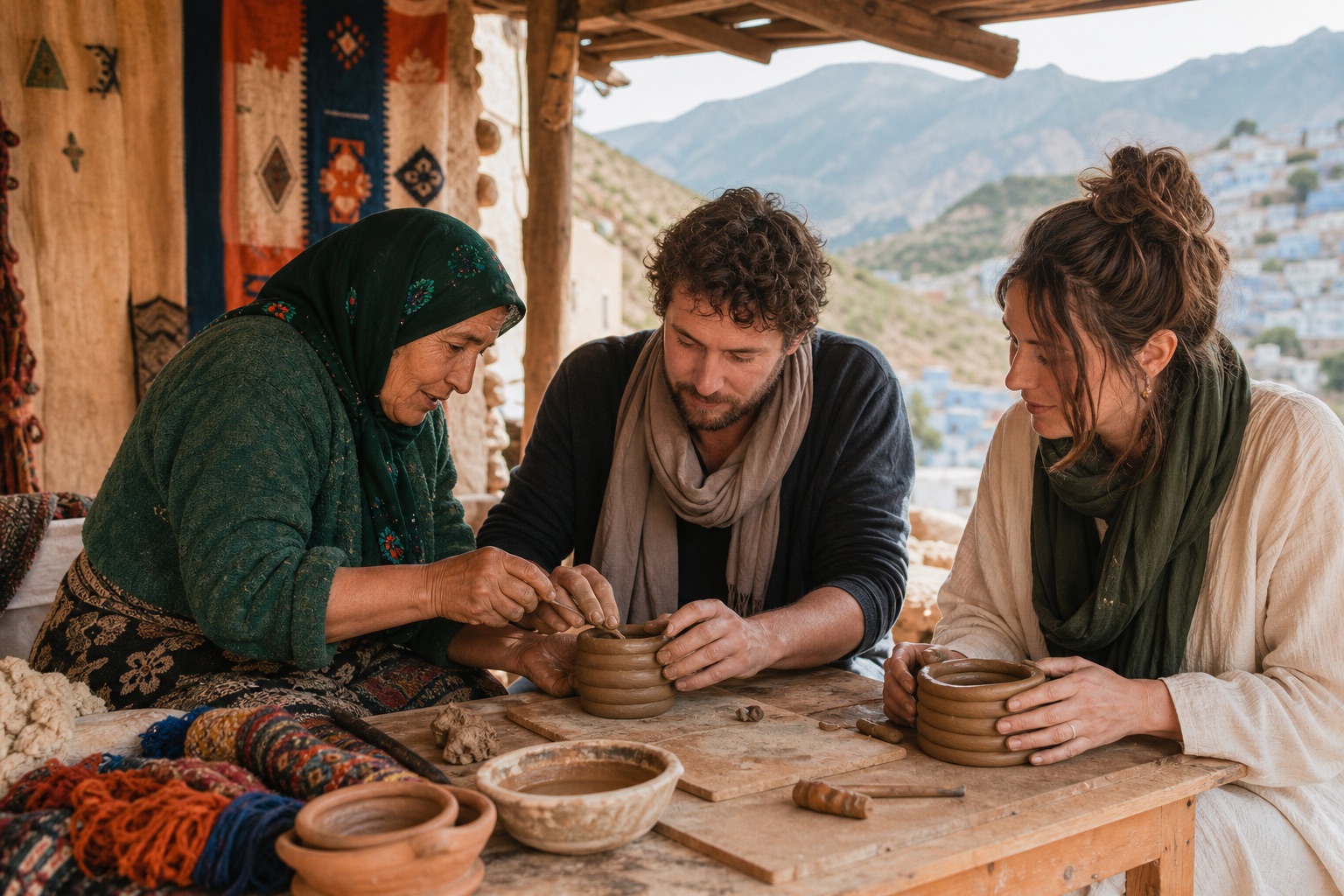
Chefchaouen offers more than blue lanes and handsome photographs. You can work at a loom, cook with a local host, practise Darija or paint with an artist in town. For Rif pottery, allow a full rural day. Photography and film are worth considering only when a tutor and current programme are named.
First ask whether the lesson happens in Chefchaouen or requires a journey from Chefchaouen. A pottery day in a Rif village needs different shoes, transport and time from a class inside the Medina.
Choose your learning route
| If you want to… |
Start with |
Ask before booking |
| Try a traditional loom |
Wool weaving |
Active loom minutes, named artisan and realistic output |
| Learn with a rural pottery practitioner |
Rif pottery |
Village, consent, making stages, firing and transfer |
| Cook from market to meal |
Cooking |
Host, personal tasks, kitchen controls and recipes |
| Use practical Moroccan Arabic |
Darija |
Named teacher, phrases covered and speaking feedback |
| Make a visual study |
Painting |
Named artist, technique, feedback and the piece you take home |
| Improve an image sequence |
Photography |
Assignment, critique, city time and subject consent |
| Join a dated creative programme |
Film workshops |
Current dates, tutor, practical task and venue |
Chefchaouen genuinely supports all seven learning routes, even when no current class is available. Film is the clearest example: past festivals hosted workshops. However, you should wait for a new programme with a tutor, task and date before planning around it.
In, from or around Chefchaouen?
The city page owns the Medina, Kasbah, Outa el-Hammam, Bab El Ain and Ras El Maa as orientation entities. Akchour, Talassemtane National Park, Bouhachem Natural Park and Rif villages are separate destinations around the city. The direct pottery itinerary explicitly leaves Chefchaouen and drives for about an hour to a village; it is a pottery day from Chefchaouen.
This is more than a wording detail. A steep pedestrian Medina class and a full rural day require different footwear, access questions, transfer time and safeguarding. Ask for the meeting point, teaching site and return plan separately.
Match the outcome to the time
The clearest weaving lead publishes a roughly 90-minute introduction but allocates about 30 minutes to terminology and loom practice. It also says a larger textile takes roughly four hours. A short class can still be valuable when the outcome is honest: orient the loom, learn one action, receive feedback and understand the next stage. It should not inherit the output of the longer format.
Use the same test for pottery and painting. Ask what you make yourself, what the teacher corrects and whether drying, firing or finishing happens after you leave.
Taste, make and take home
A food tour helps you understand Chefchaouen through tasting and local stories. For hands-on cooking, choose a session with ingredient shopping, supervised preparation, a full meal and recipes to keep. Ask who hosts the class, where it takes place and how allergies are handled.
The useful result is not simply eating the meal. You should understand the ingredients, preparation order, heat and seasoning well enough to try the dish again at home.
A useful 90-minute Darija class
A short Darija introduction can teach greetings, essential phrases and a small conversational exchange. It cannot promise fluency, immersion or a CEFR level. Ask the teacher to model a phrase, hear you use it, correct pronunciation or form and repeat it in a second situation.
The published Darija session takes place in a rooftop home. Ask for the address, access details and host confirmation before you go. Enjoy the Medina view, but make sure the session still gives you enough time to speak and practise.
Turn Chefchaouen’s colour into a real creative lesson
A painting workshop needs a defined study, named artist and feedback. A photography workshop needs an assignment, selection, critique and a revised decision. For real tuition, choose a photographer who sets an assignment, reviews your images and helps you try again.
The strongest photography workshop we found is a multi-city programme with Chefchaouen as one stop. Find out how many hours belong to the town and whether the tutor reviews your images. Always request permission before photographing people, homes or workplaces, and obtain clear consent before publishing identifiable images.
Check the date on creative programmes
Chefchaouen’s July 2026 film festival included workshops and masterclasses at Medina, Kasbah and cultural-centre venues. Those dates have passed. Wait for a new programme naming its tutor, practical task, venue and contact before adding film tuition to your itinerary.
Ask these before you enquire
- Current named artisan, cook, teacher, artist, photographer or film tutor
- Exact city meeting point, rural teaching site and transfer time
- Minutes of active practice, individual feedback and what you take home
- Group size, teaching language, starting level and accessibility
- Practitioner consent, credit, compensation and photography boundaries
- Tool, clay, kitchen, allergen, transport and safeguarding controls
- Firing, drying, finishing, image rights and take-home arrangements
- Explicit alcohol-free venue, recipes, programme and inclusions
- Current dates, price, deposit and cancellation terms
The possible hosts below have not confirmed live availability or a partnership with GoLearnTo. Their open questions remain visible so you can ask about the teacher, lesson, location and price before arranging your trip.
Keep exploring
Read what Medina means in a living city, compare another northern learning base in Tetouan, or return to the full Morocco learning map. In Chefchaouen, slower is useful: one serious workshop, one unhurried conversation and enough time to find your way back without pretending every blue staircase is a shortcut.
Enquire with the useful details
Tell GoLearnTo the skill, dates, starting level, preferred language and any access, dietary or transport needs. An enquiry asks for information or an introduction; it does not confirm availability, verification, safety or suitability.
What we checked
Sources behind the local details
We used these sources for local history, geography and cultural context. Opening times, access and programmes can change, so confirm current details with the venue or host. Sources checked on 14 August 2026.
- Moroccan National Tourist Office
- UK Government travel advice