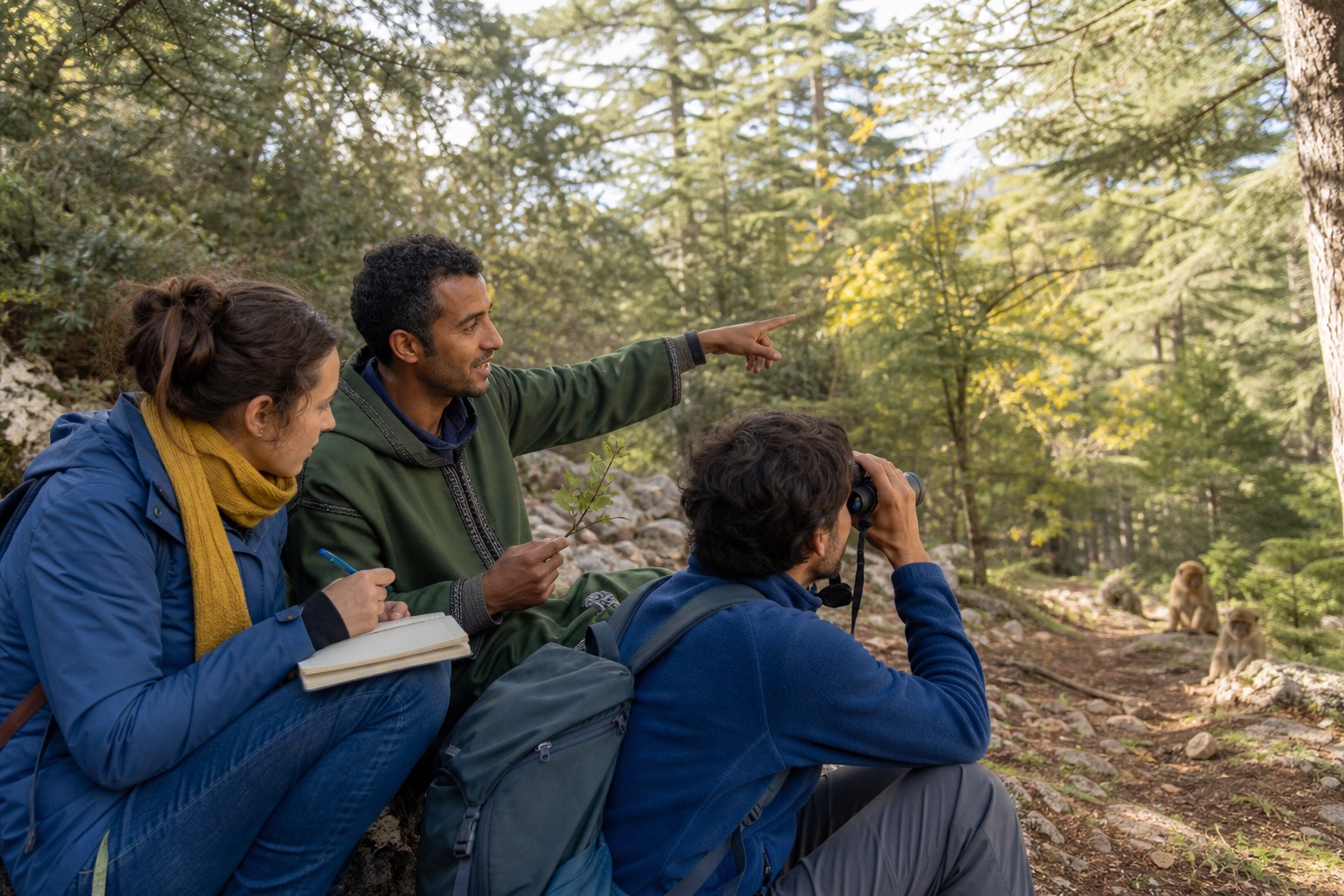
Ifrane is a Middle Atlas city, not shorthand for every cedar forest, lake or winter activity nearby. First ask where the learning actually happens. It may be inside the city, within Ifrane National Park, near Azrou, at a named wetland or at Michlifen.
The air can feel cool under the green cedar trees even when the open road is bright and warm. Listen for birds before reaching for a camera. Pack a layer, water and shoes for the named surface—not for a generic “forest walk.” Keep food packed away and let the guide set the distance from macaques.
Ifrane supports seven learning routes. Three possible hosts are listed below. Cooking, craft and university events are excluded because we could not find a current short format that travellers can join.
Choose your Ifrane learning route
| If you want to… |
Start with |
What to ask |
| Read forest, water and visitor pressure |
Guided walking |
Exact site, route, guide, field task and ecological boundary |
| Observe birds or macaques responsibly |
Wildlife field learning |
Habitat, distance, no-feeding rule and guide intervention |
| Decode the city’s built form |
Architecture |
Route, sources, public access and interpretation method |
| Understand planning and power |
Urban history |
Historian or guide, named sources, viewpoint and later change |
| Improve landscape images |
Photography |
Tutor, exercises, critique and wildlife conduct |
| Learn rather than merely ride |
Horse-riding skills |
Instructor, horse welfare, route, assessment and emergency plan |
| Learn on snow when it actually exists |
Ski and snowboard skills |
Live snow, road, lift, terrain, instructor and closure updates |
City → park → province
Ifrane city owns urban learning and experiences whose meeting point or teaching site is clearly disclosed there. Ifrane National Park is a protected landscape with separate access and conduct questions. Azrou, Cedre Gouraud, Dayet Aoua, Lake Afennourir and Michlifen must be named as excursions rather than quietly folded into the city.
A Fes pickup, provincial label or marketplace category proves none of those locations. Every profile must state the actual teaching site and transfer.
Site → status → season
A lake can be near Ifrane without being inside the same protected unit or holding the same designation. Ifrane’s Wetland City accreditation does not make every nearby lake a Ramsar site.
Ask which wetland you will visit, its current water level and how you reach it. Follow the site’s access and wildlife rules. Even in a dry season, a good guide can explain how water, wildlife and human pressure change the landscape.
Tree → habitat → pressure
Atlas cedar is part of a living system shaped by water, grazing, extraction, climate, tourism and rural livelihoods. A forest lesson should connect species identification to habitat and stewardship rather than use a cedar grove as a photo backdrop.
Swisscontact’s work identifies concentrated visitor pressure at emblematic park sites. That supports a conservation-led selection test, not an implied endorsement of any operator.
Observe → distance → no feeding → record
Barbary macaques are conservation subjects, not props. A responsible format publishes distance, no-feeding, no-touching, no-crowding and no-baiting rules; controls waste and photography; and explains how the guide intervenes.
Sightings cannot be guaranteed. Recording habitat, behaviour and visitor pressure can remain a valid learning outcome when no animal appears.
Street → plan → power
Ifrane’s chalet forms, green space, street pattern and institutions reveal a Protectorate-era hill station and garden-city project. “Little Switzerland” is a nickname, not an adequate history.
Architecture learning observes form and plan. History learning asks who planned the city, for whom, what power the design expressed and how the place changed after independence. Neither format assumes access to private buildings or the university.
Ifrane’s learning-city status describes the wider community. A visitor still needs a specific teacher, route or practical programme.
Ifrane’s UNESCO learning-city membership concerns civic learning policy. Al Akhawayn University is an active higher-education institution. Neither fact proves public visitor access, a tourism partnership or a bookable lesson.
A university event belongs only after its organiser, date, registration, language, accessibility, photography rules and public access are confirmed. None is shown as an experience card here.
Snow → surface → instruction → closure
Snowfall or a forecast does not mean roads, lifts, terrain and lessons are operating. Confirm the hotel and ski-station details separately, because they are not necessarily the same operator.
Before a winter lesson, confirm same-day snow, surface conditions, road status, open terrain and the assigned instructor. Ask about equipment, age and ability limits, insurance, cancellation and the non-snow fallback. Snow is seasonal, even when the photographs look perfect.
Horse learning starts with welfare
A ride becomes a learning experience only when the instructor assesses the rider, teaches handling and movement, supervises practice and gives feedback. Look for guided observation, a practical task and time to discuss what you found.
Before riding, ask who owns and handles the horse, how its workload is managed and whether rider or weight limits apply. Check the tack, route, rest, water, shade, injury response and veterinary access. Atlas Crown has not yet answered these questions for GoLearnTo.
Photography must not rewrite the conduct rules
Ifrane gives photographers forest, wetland, planned architecture and strong seasonal change. A real workshop still needs a named tutor, a field assignment, clear camera or phone requirements and time to review images.
No photograph justifies feeding, baiting, touching, crowding or blocking wildlife. For a real workshop, choose a named teacher and an activity you practise yourself.
What not to plan around
We found no current Ifrane cooking class or city-based Amazigh craft workshop. The university does not advertise drop-in visitor courses, and marketplace hiking or birding pages do not identify a teacher. Do not build the trip around these until a current host publishes clear details.
All routes and inclusions must be explicitly alcohol-free. Return to Morocco, compare the wider Atlas Mountains, or review the season-planning guide.
Enquire with the useful details
Tell GoLearnTo the exact site or skill, dates, starting ability, group, preferred language and access or medical needs. Your message starts the fact-check with a possible host; it does not reserve a place.
What we checked
Sources behind the local details
We used these sources for local history, geography and cultural context. Opening times, access and programmes can change, so confirm current details with the venue or host. Sources checked on 14 August 2026.
- Moroccan National Tourist Office
- UNESCO