Rabat suits travellers who want structured language study, museum context, practical craft and Atlantic lessons without Marrakech’s pace. Start with one skill, then use Chellah, the medina and the national collections to deepen it.
Rabat offers twelve useful learning routes. Some craft sessions take place across the Bouregreg in Salé, so check the meeting point before you travel.
Choose your Rabat learning route
| If you want to… |
Start with |
What to ask |
| Practise Moroccan Arabic |
Arabic and Darija |
Variety, placement, teacher, hours and feedback |
| Prepare a Moroccan meal |
Cooking |
Kitchen, host, hands-on stages and food controls |
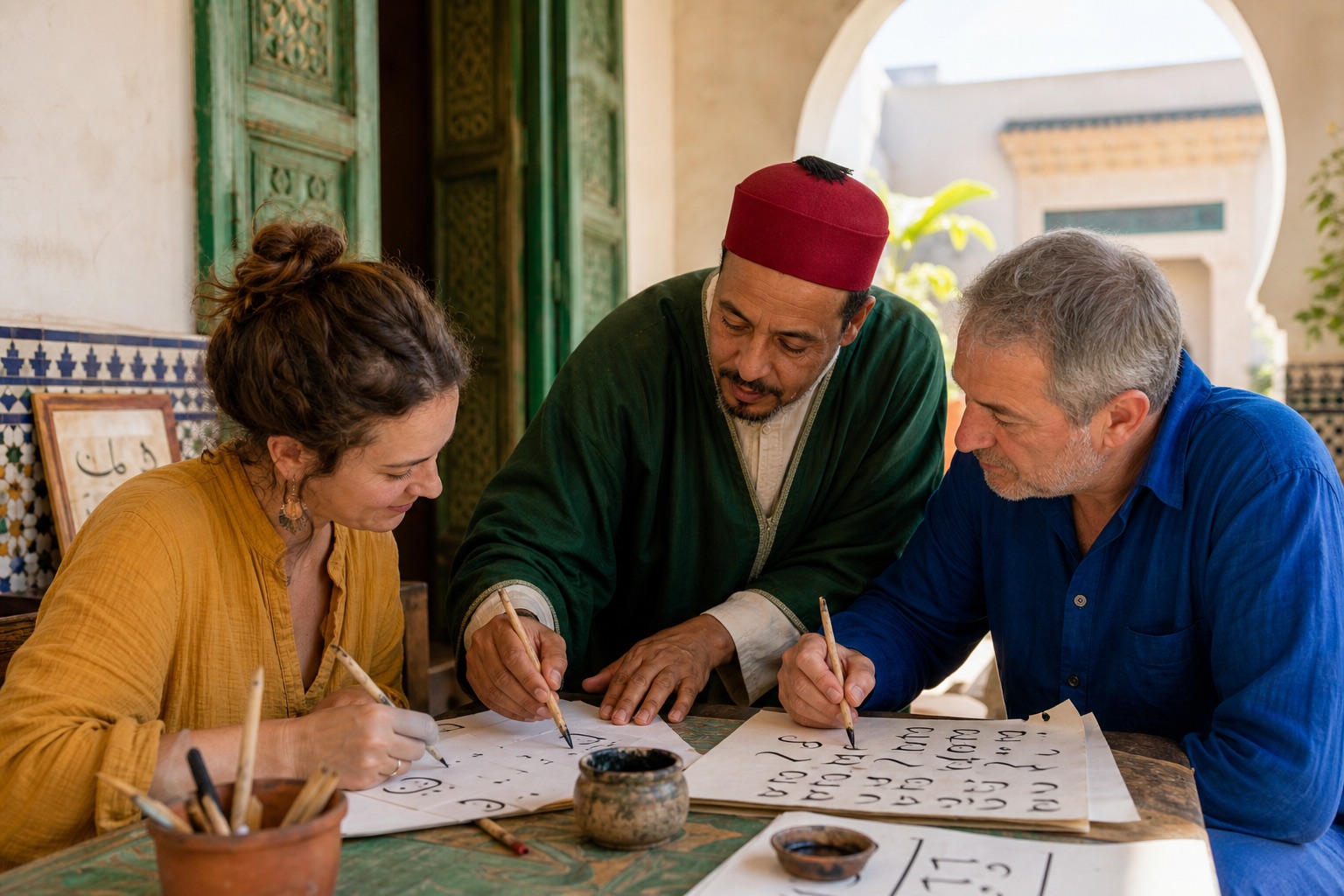
| Build letterforms |
Calligraphy |
Script, calligrapher, corrected strokes and a take-home sample |
| Make a leather object |
Leather craft |
hands-on stages, tools, material and finish |
| Make wearable craft |
Jewellery |
Artisan, technique, attribution and safe finish |
| Shape clay |
Pottery |
Rabat site, what you do, drying and firing |
| Develop a visual study |
Painting |
Artist, medium, exercise and feedback |
| Practise a textile technique |
Embroidery |
Stitch, motif, feedback and output |
| Try a wood process |
Woodworking |
Craftsperson, task and machine boundary |
| Learn in Atlantic water |
Surf coaching |
Beach, conditions, ratio, rescue and no-session plan |
| Read archaeological layers |
History |
Sources, route and interpretation method |
| Compare planned city layers |
Architecture |
Guide, field prompts, permissions and access |
No urban-architecture host is listed yet. Until a guide publishes a focused route and field method, use the architecture page as a comparison checklist.
Rabat, river or Salé?
This hub owns Rabat Medina, Kasbah of the Udayas, Hassan, Agdal, Hay Riad, the Ocean district, Rabat’s corniche, Chellah and capital institutions. Salé Medina and the Oulja artisanal complex are across the Bouregreg in Salé. Temara, Skhirat and Kénitra are separate places. Rabat–Salé Airport is an arrival node outside the centre.
The tram makes Rabat and Salé easy to combine, but they remain different cities. Each experience should give you a clear meeting address and say which city it belongs to.
Use museums to prepare for the practical lesson
Rabat’s museums cover modern art, chronological archaeology, photography and adornment. Chellah adds a seven-hectare archaeological landscape with multilingual audio interpretation. Use them to study materials and forms before a workshop; admission alone does not include painting, jewellery making or excavation practice.
A practical lesson begins when a teacher gives you a task, watches the attempt and helps you improve it. Pair the museum visit with a separately booked workshop when you want hands-on learning.
Darija or Modern Standard Arabic?
Direct Rabat schools publish both Darija and Modern Standard Arabic. Darija supports everyday communication; formal Arabic serves different reading, media or academic goals. A course should name its target rather than advertising “Arabic immersion” as one undifferentiated product.
Find out how the school places your level and how many teacher-led hours you receive. Class size affects how often you speak. Prepared practice in markets or on transport can help the language settle into real life.
Protect time for cooking
One direct home-cooking lead publishes a three-to-four-hour experience with ingredient selection, side-by-side preparation and a shared meal. The useful next question is how much of that time belongs to personal cooking, which dishes are host-led and how feedback works.
A useful class names the kitchen and the cook, explains the menu and gives you meaningful preparation time. Share allergies in advance and confirm that the ingredients and meal are alcohol-free.
School, workshop or short session?
Rabat craft results mix language-school cultural programmes, multi-craft operators, museum collections, marketplace distribution and the Salé craft complex at Oulja. GoLearnTo separates them.
Rabat has leads for leather, jewellery, painting, pottery, calligraphy, embroidery and carpentry. For each craft, look for the named maker and one clear task you can complete safely. A broad programme may use different teachers for different skills.
Cross the river for Oulja pottery
Oulja belongs to Salé, across the Bouregreg from Rabat. Its shops and studios can introduce the area’s pottery traditions. For hands-on learning, find a named artisan who offers a current participant workshop and gives the exact Salé address.
For any pottery session, ask what you will shape, who corrects your technique, how the piece dries and whether it is fired. Confirm collection or delivery before you book. Read the kiln-firing glossary before trusting a same-day souvenir promise.
Use Rabat’s museums for ideas, then book a separate workshop when you want to make or practise something yourself.
The National Museum of Adornment can help a learner understand materials, forms and social context. The Mohammed VI Museum can support visual analysis. The National Photography Museum establishes a serious photography institution. None proves that a jewellery, painting or photography workshop is available.
Rabat has promising jewellery and painting workshops, although current schedules still need checking. We found no Rabat photography course with a named teacher, assignment and image review.
The beach can move the lesson
A surf school describes a Rabat base, beginner and intermediate coaching, Rabat beach and movement according to conditions. Ask for the day’s exact beach before arranging transport.
Confirm the meeting point, instructor and planned beach. A good coach explains the equipment, keeps the group manageable and changes the plan when the ocean changes.
Archaeology and architecture need methods
UNESCO frames Rabat as both modern capital and historic city. Chellah and the Museum of History and Civilisations can support chronological and site-based archaeology interpretation. A useful guide asks you to compare material, date, urban layer and source—not merely listen to a list of dynasties.
Architecture needs its own field method: plans versus streets, historic fabric versus modern planning, institutional use and current conservation. Until a current route publishes that method and a named guide, the skill stays visible without a host listing.
Dated culture expires
Rabat’s 2026 World Book Capital programme, IRCAM events and Mawazine edition prove active literary, Amazigh and music ecosystems. Mawazine used stages in both Rabat and Salé. Completed programmes do not become permanent lessons.
Rabat has Amazigh-language and music institutions, but we found no short visitor course with current dates, a named tutor, practical task and feedback. Do not assume an institution offers drop-in classes.
Ask these before you enquire
- Exact Rabat or Salé municipality, bank and teaching address
- Current legal operator and named teacher, artisan, host, guide or instructor
- What you do, active time, feedback, repetition and useful result
- Group size, language, level, access and safeguarding
- Food, leather, metal, clay, kiln, pigment, textile, wood and sea controls
- Home, museum, site, neighbourhood and practitioner consent
- Transport, collection, delivery, conditions and no-session terms
- Explicit alcohol-free venue, recipes, route and inclusions
- Current dates, price, deposit and cancellation
The possible hosts below have not confirmed live availability or a partnership with GoLearnTo. Use their open questions to compare the teacher, place, active learning time and price before enquiring.
Keep exploring Morocco
Return to Morocco, compare the urban-learning framework in Casablanca, or explore the craft depth of Fes. Rabat’s advantage is disciplined contrast: collection and practice, capital and medina, Rabat and Salé, observation and feedback.
Enquire with the useful details
Tell GoLearnTo the skill, dates, starting level, preferred language and any access, dietary, material or water-confidence needs. An enquiry asks for information or an introduction; it does not confirm availability, verification, safety or suitability.