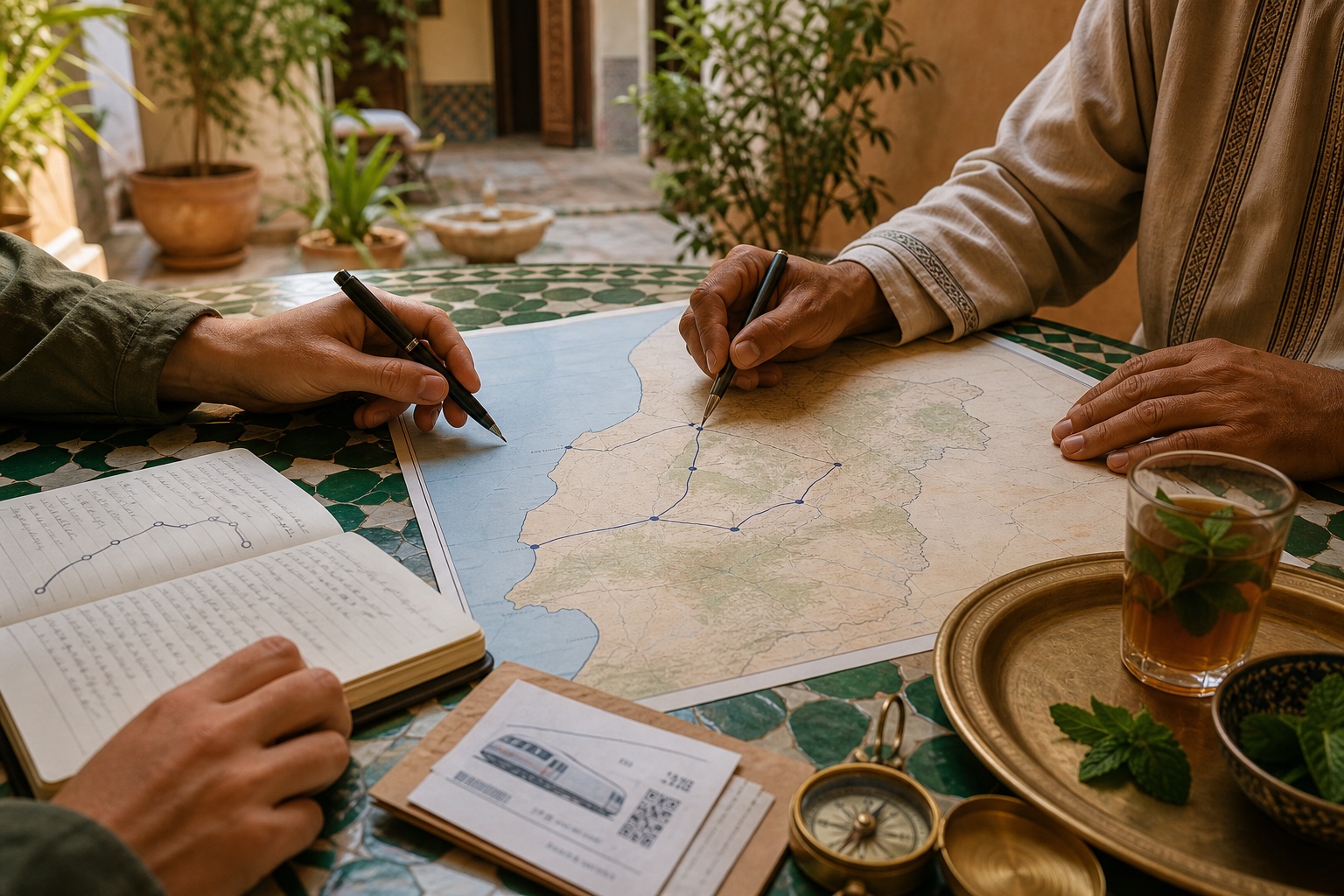
Planning Morocco by a list of famous stops is easy. Planning it around something you genuinely want to learn takes a little more thought—and usually produces a much better trip.
This library helps you make the decisions in the right order: choose the skill, find its strongest place context, protect enough teaching time, and verify the person who will teach you. Then we can discuss airports, shoes and whether three cities in five days is ambition or cardio.
Start with your real question
| Your question | Best place to begin |
|---|---|
| I have never taken a learning holiday | Your first learning holiday in Morocco |
| Which month suits my skill? | When to learn in Morocco, by skill |
| Can these places fit into one trip? | Travel times and learning routes |
| I want a 7-, 10- or 14-day plan | Morocco learning itineraries |
| Is this really a workshop? | How to choose a workshop |
| What is the difference between a tour and a class? | Tour, demonstration or class? |
| What should the price include? | Costs, tipping and fair pay |
| Is the experience suitable for me? | Safety, insurance and activity levels |
Plan the trip around teaching time
A learning day is not the same as a holiday day. Airport queues, road transfers, checking in and finding the meeting point all use time. They may be necessary, but they are not contact hours.
Use a simple budget:
- Transfer: moving between bases.
- Orientation: finding the venue and understanding the format.
- Practice: the minutes when the learner is actively doing the skill.
- Feedback: correction, explanation and a second attempt.
- Rest: the part ambitious itineraries mysteriously forget.
One main base with a contrasting second place often works beautifully. Fes plus Chefchaouen can link structured language or material craft with Rif context. Marrakech plus Imlil can connect cooking or craft with High Atlas learning. The correct pair depends on the skill—not on who drew the prettiest route map.
Choose with confidence
The word “workshop” can describe a corrected lesson, a ten-minute demonstration or a shop visit with a chair. All three can be enjoyable. They should not be sold as the same thing.
Before enquiring, look for five observable details:
- Who teaches or interprets?
- What does the learner do?
- What explanation or correction is provided?
- Is there time to try again?
- What method, object, recipe, phrase set or skill plan remains afterwards?
For cultural knowledge and living craft, add two more questions: who consented to the visitor format, and how does the practitioner or community benefit? GoLearnTo’s workshop guide explains the full test.
Travel with Moroccan context
Morocco is multilingual, geographically varied and not governed by one visitor rulebook. Darija, Modern Standard Arabic and Amazigh languages serve different learning goals. French and Spanish have different regional and educational contexts. Start with the language guide before choosing “Arabic immersion” as though it were one uniform product.
Practical context deserves the same precision:
- What to wear for workshops and learning trips
- Learning during Ramadan and religious holidays
- Food allergies and dietary needs
- Accessibility for learning holidays
These guides describe questions and barriers. They do not declare an entire city accessible, a dish universally safe or every Moroccan schedule identical. Morocco contains too much real life for that kind of shortcut.
Find the right shape for your group
Families need age-appropriate tools, sensible teaching blocks, supervision, rest and a meaningful role for the child. “All ages welcome” is a cheerful phrase, not a safeguarding plan.
Solo learners need different answers: will the group definitely run, is private tuition the fallback, what supplements apply, and how does the evening return work? A social-looking retreat can still be one learner, one room and one unexpected invoice.
Understand the subject before choosing the listing
Our field guides go deeper into the learning itself:
- Argan: landscape, oil making and honest workshops
- Gnawa in Essaouira: music, movement and respect
- Leather in Fes: interpretation versus hands-on craft
- Moroccan carpet weaving
- Morocco’s communal ovens
- Ras el hanout
- Tagine technique
- Zellige in Fes
Use them before an enquiry. A better question usually produces a better answer—and occasionally saves you from discovering that “zellige making” meant painting a square tile next to a gift shop.
How this library stays honest
Practical facts change. Transport, weather, religious dates, prices, teachers and accessibility details need current confirmation. Each guide carries a review date and selected public references. Commercial competitors stay in our private research ledger rather than receiving promotional links from the page.
Provider profiles also keep their evidence state visible. HOLD means the proposition is credible enough to research, but important current details remain unresolved. Claimed means the provider controls or has responded to the profile. Verified requires stronger operational evidence. None of these labels is a guarantee of suitability for every learner.
Begin with the complete Morocco learning map, choose the guide that resolves your biggest uncertainty, and then send one well-formed enquiry. That is slower than clicking the first shiny card. It is also far more likely to lead to a real lesson.
Three useful ways through the library
I know the skill, but not the place
Start on the Morocco learning map. Compare the cities and regions attached to that skill, then open the relevant place pages. A pottery learner may need to distinguish Fes workshop traditions from Rif pottery around Chefchaouen. A surfer should compare Taghazout’s coaching ecosystem with Essaouira’s wind conditions. The point is not to collect destinations. It is to find the place where the teaching has the strongest local reason to exist.
Next, check the subject guide if one exists. It will help you recognise the stages, tools and limits of a credible session. Only then compare provider profiles and send an enquiry.
I know the place, but not the skill
Open the city or regional hub first. Its skill cards are evidence-qualified relationships, not a promise that every activity runs every day. Look for the difference between a skill that belongs naturally to the place and one that merely happens to be sold there.
In Fes, that may mean zellige, pottery, leather, weaving, calligraphy, cooking or Arabic. In Essaouira, the stronger learning logic may involve Gnawa, wind sports, surfing, photography or thuya woodwork. Choose the activity that gives you a useful learner role—not the card with the loudest adjective.
I know my dates and limits
Begin with when to go, travel times and the relevant suitability guide. Then remove anything that depends on weather, access, group formation or teaching hours you cannot confirm. This may leave fewer choices. Excellent. A shorter honest shortlist beats a magnificent imaginary itinerary.
What to save before you enquire
Create one small note for each serious option:
| Field | What to record |
|---|---|
| Skill outcome | What you hope to practise, understand or make |
| Place | Exact city, village, beach, mountain area or meeting point |
| Format | Tour, demonstration, workshop, lesson, course or retreat |
| Teaching time | Active practice and feedback—not total excursion length |
| Practitioner | Named teacher, guide, artisan, coach or interpreter |
| Current status | Date, availability, minimum group and what remains unverified |
| Practical fit | Language, mobility, dietary, equipment and supervision needs |
| Full cost | Teaching, materials, transfers, accommodation and cancellation terms |
This note becomes your comparison tool and your enquiry brief. It also prevents a common problem: remembering the beautiful description while forgetting that nobody explained who teaches.
A final Morocco rule
Leave a little room for tea, conversation and the useful surprise you could not schedule. Good learning needs structure; good Moroccan hospitality does not always obey a stopwatch. Protect the lesson, confirm the essentials and avoid packing every empty hour. The goal is not to return with the busiest camera roll. It is to return able to cook, cut, speak, read, paddle, weave or understand something better than before.
Evidence
Selected references
Official and institutional references used for place, heritage or practical context. Commercial operators and marketplaces are kept in our private research ledger rather than promoted here. Reviewed 15 August 2026.