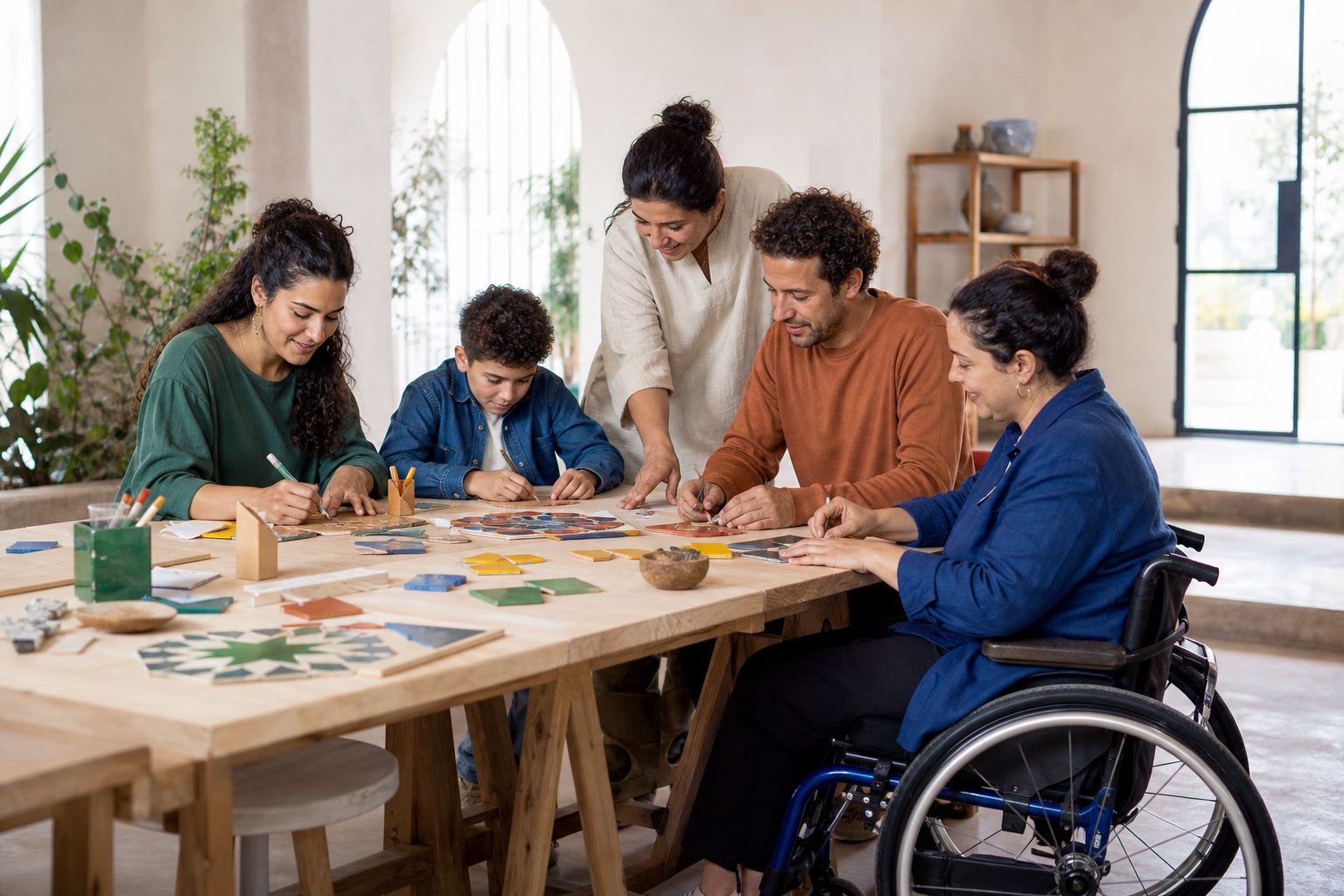
Choose a Morocco family learning experience by the child’s age, interest, attention, learner role and the real tools or conditions involved. “All ages welcome” is not enough. Ask who supervises, what the child does, how long it lasts, what can be adapted and what happens when the family needs a break.
Give the child a real learner role
Children notice quickly when the “family workshop” is an adult class with a colouring sheet nearby.
A useful role is specific and safe:
- Mix, shape or layer a food stage with suitable supervision
- Assemble a prepared mosaic pattern
- Practise simple Darija greetings with feedback
- Try a bounded weaving or clay action
- Observe and sketch architectural details
- Learn a surf or movement skill in an age/level-matched group
- Record a field note, map symbol or photo story
The role should contribute to the session without turning the child into entertainment for adults or the practitioner.
Match the activity to age and attention
Chronological age is only a starting point. Ask about:
- Interest in the skill
- Ability to follow the teaching language
- Comfortable active time
- Fine-motor or physical demands
- Sensory environment
- Heat, hunger and sleep
- Need for movement or quiet
- Previous tool, water, animal or mountain experience
A two-hour hands-on lesson can be easier than a one-hour talk. A patient child may enjoy detail; another may learn better through short stages and breaks. The provider should explain the format rather than promise universal delight.
Tools, kitchens and real conditions
Cooking
Confirm knives, heat, stove position, ingredients, allergens, handwashing, adult supervision and which stages suit the child. Read the food-needs guide.
Craft
Clay and prepared mosaic assembly may be adaptable. Tile cutting, metalwork, leather chemicals, dyes, dust and kiln areas need stronger controls and age limits. A child can learn the design or process without using every tool.
Surf and water
Require age/ability grouping, named instructor, ratio, equipment, water-confidence information, changing arrangements and no-session rule.
Mountains, desert and animals
Check walking distance, ascent, weather, rest, water, toilet, transport, guide, animal welfare and emergency plan. A scenic family label does not reduce altitude or heat.
Protect the family Learning Time Budget
A family route needs space for meals, sleep, unplanned stops and the occasional strong opinion about socks.
For a seven-day trip, one main base often works well. Choose one protected practical session, one context activity and one optional second attempt. Add another base only when the transfer is manageable and the new place changes the learning meaningfully.
Do not schedule:
- A late arrival before an early practical class
- Long road transfer plus a high-concentration workshop
- Adult-length sessions with no break
- Repeated early starts
- Every meal as an organised learning event
Children—and their parents—are allowed to eat without a worksheet.
Ask who supervises
Provider pages should state:
- Parent/guardian presence requirement
- Instructor responsibility
- Adult-to-child ratio
- Private or mixed-age format
- Bathroom and break arrangements
- Photography and consent
- Lost-child/emergency contact process
- Safeguarding policy where relevant
- What happens if a child does not want to continue
UNICEF’s child-protection work in Morocco provides national context, but it does not verify a tourism provider. The exact operator must show its own safe practice.
Choose a meaningful outcome
Good family outcomes are modest:
- A recipe and one technique the family can repeat
- A small object made through safe participant stages
- A phrase set practised with a teacher
- A surf or movement progression note
- A sketch, field notebook or observation method
- A better understanding of who makes something and why consent matters
Avoid forcing a take-home souvenir when the material needs finishing or the craft does not suit a quick output.
The Family Tool-and-Time Test
| Check | Ask |
|---|---|
| Learner role | What does the child personally do? |
| Age and level | What is the minimum and why? |
| Active time | How long before a real break? |
| Tool/condition | Knife, heat, chisel, water, animal, altitude or traffic? |
| Supervision | Who is responsible and what is the ratio? |
| Food/access | Allergens, toilet, seating, sensory and mobility needs? |
| Outcome | What can the child realistically retain? |
| Fallback | Can the task adapt or stop without penalty? |
Send the family enquiry
Include children’s ages, interests, current level, preferred language, dietary/access needs, water confidence and the length of session that usually works. Ask for the assigned teacher, exact venue, private/mixed format, tool controls, breaks, total price and cancellation.
A great family lesson does not need to keep everyone smiling every minute. It needs to be safe, respectful and genuinely participatory—with enough flexibility that nobody is trapped in a three-hour demonstration while lunch becomes a family emergency.
Choose the family format before the activity
A private session can adapt pace, language and breaks more easily. A mixed group may provide social contact but follow a fixed rhythm. A host-led stay can simplify meals and transfers, while an independent day workshop gives the family more control over accommodation.
Ask whether adults and children learn together, split into levels or take turns. If one adult must supervise constantly, that person may not receive the workshop advertised to them. Price and describe the family’s real learner roles.
Age ranges need an explanation
“Suitable from age six” should connect to the task. Can the child hold the tool, follow the safety instruction, reach the surface and remain engaged for the teaching block? Two children of the same age can have different needs, but the provider should still explain why its minimum exists.
For teenagers, avoid automatic “children’s” content. A motivated teenager may want the adult technique, proper feedback and a serious outcome. Confirm level and maturity with the teacher rather than reducing the task to decoration.
Build a family-friendly day
Use one main learning block, an unhurried meal and simple transport. Add optional sightseeing only after checking energy. Heat, unfamiliar food, travel and concentration all use the same family battery.
Carry water, sun protection, medication and familiar snacks where appropriate. Confirm toilets, handwashing, changing, shade and quiet space. For food sessions, use the dietary guide. For physical activities, use the activity-level guide.
Safeguarding questions belong in the enquiry
Ask who teaches, who else will be present and whether a parent remains throughout. Confirm photography rules, transport supervision, private spaces and emergency contact. A warm host and a child-friendly website do not replace a safeguarding process.
Children should not be photographed for promotion without informed permission. Visits to homes, cooperatives or community settings also require respect for local children’s privacy.
Let the child own a result
A recipe they can repeat, three Darija phrases, a small finished object or one surf skill gives the day a clear ending. Perfection is unnecessary. Ownership matters.
Ask the teacher to explain what a realistic result looks like for each age and how adults can continue it at home. The best souvenir may be slightly uneven, covered in flour and accompanied by a very long explanation from its proud maker.
Evidence
Selected references
Official and institutional references used for place, heritage or practical context. Commercial operators and marketplaces are kept in our private research ledger rather than promoted here. Reviewed 15 August 2026.