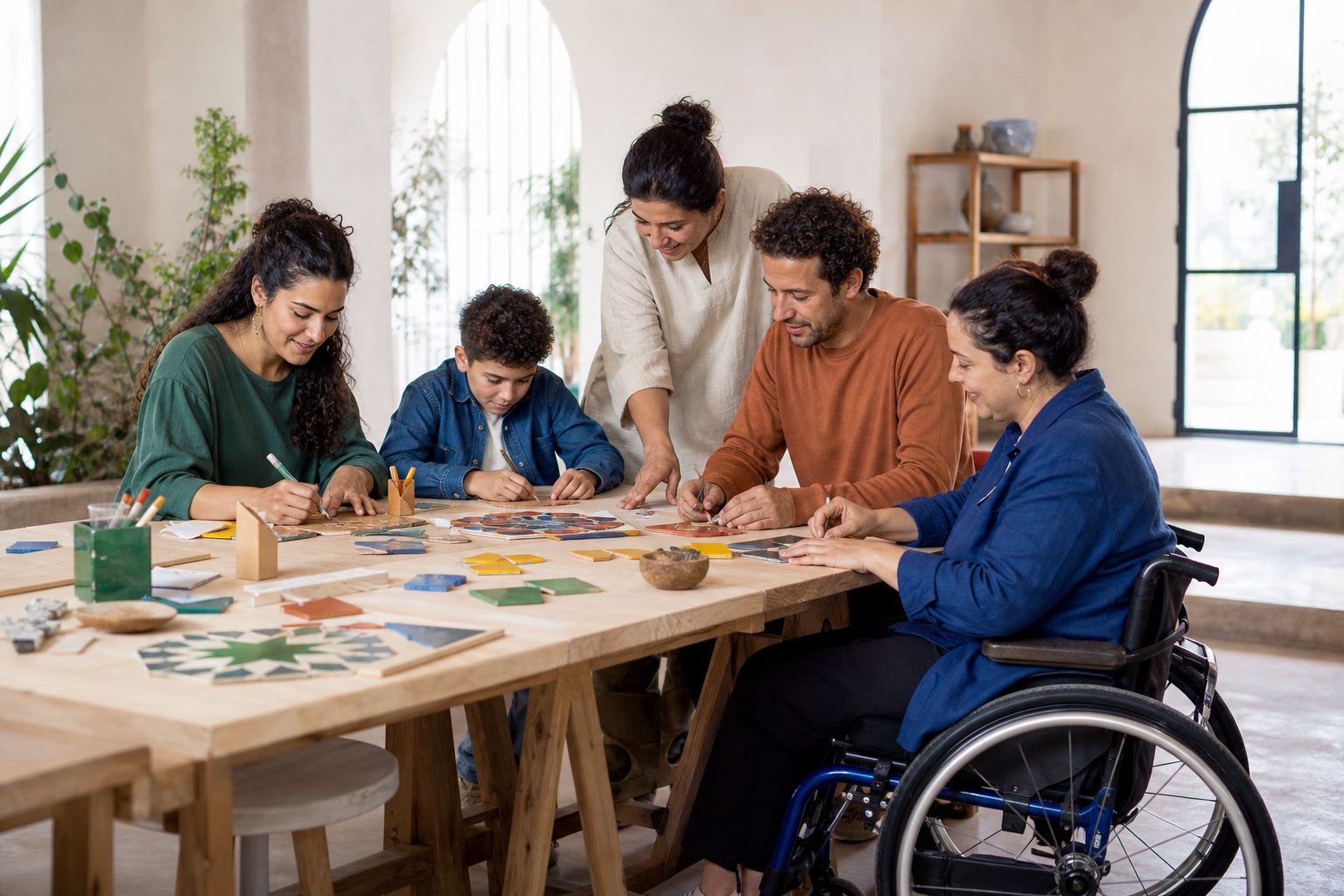
Accessibility is a chain: arrival, transfer, street, entrance, circulation, learning position, toilet, communication and return. One accessible airport or ramp does not prove the whole experience works. Ask for specific measurements, barriers, assistance and alternatives rather than a city-wide “accessible” label.
Build the Venue Access Chain
| Link | What to confirm |
|---|---|
| Airport or station | Assistance request, meeting point, luggage and toilet |
| Transfer | Vehicle entry, seating, mobility aid, storage and driver support |
| Street or path | Surface, width, gradient, steps, crowds, shade and rest |
| Entrance | Threshold, door, lift/ramp and alternative route |
| Internal movement | Width, level changes, seating and lighting |
| Learning position | Bench/table height, reach, grip and tool adaptation |
| Communication | Hearing, visual, language, caption, tactile or quiet-space needs |
| Toilet | Location, route, dimensions and support |
| Emergency/return | Exit, contact, pickup and fallback |
The chain is only as useful as its weakest unresolved link.
Airport assistance is a start
ONDA publishes airport information. Marrakech airport states that ramps, lifts and staff assistance are available for passengers with reduced mobility. Casablanca airport describes advance communication with the airline and lists adapted features.
Use those services and confirm them for your journey. Then keep going. Airport support does not automatically cover the taxi, riad, medina route or private studio.
Ask the provider who owns each handoff. “We can help” should become a named person, meeting point and contact number.
Streets, medinas and rural routes
Historic urban areas may involve uneven surfaces, narrow passages, crowds, steps and limited vehicle access. Rural and mountain sites add gradients, loose surfaces, weather and distance from facilities.
Do not accept “the medina is inaccessible” as the final answer either. Ask for the exact route:
- Distance from vehicle drop-off
- Surface and steepest section
- Number and height of steps
- Width or turning space where relevant
- Seating and shade
- Crowd and quiet-time options
- Toilet location
- Alternative entrance or meeting site
A different route or nearby teaching venue may preserve the learning goal. It should be discussed without pretending the experience is identical.
The doorway is not the class
A step-free entrance can lead to a high fixed bench, inaccessible toilet or teaching that depends entirely on standing.
For workshops, confirm:
- Table or bench height and knee clearance
- Seated participation
- Tool weight, grip and two-hand requirements
- Assistant or companion role
- Lighting, contrast and visual demonstration
- Spoken explanation, written steps or captioning
- Noise, crowd and sensory load
- Dust, smell, ventilation and heat
- Breaks and quiet space
- Output/finishing access
For cooking, include stove/knife access, heat and ingredient communication. For surf, riding or mountain activities, discuss transfer, changing, equipment and emergency support with a qualified provider.
Adapt the learner role—not the person’s dignity
An adapted session may use:
- A seated or lower work surface
- Stabilised or lighter tools
- Prepared materials
- Assisted stages chosen by the learner
- Tactile or audio description
- More demonstration plus a bounded practical stage
- A quieter or private session
- Extra time or rest
- A different but related output
State the adaptation honestly. Do not advertise a full hands-on process if key stages become observation. Equally, do not assume a disabled learner only wants to watch.
Ask the person what outcome matters and what support works for them.
Access information belongs on provider pages
Every claimed provider profile should eventually show:
- Exact venue and access route
- Step-free status and limitations
- Toilet and seating
- Workshop-position details
- Communication options
- Transfer responsibility
- Assistance available and cost
- Emergency and cancellation arrangements
- Date the provider confirmed the information
“Contact us for accessibility” remains acceptable when the venue varies, but it should not replace known facts. A provider can publish what is fixed and ask about individual needs privately.
Send a precise access enquiry
Describe the support or barrier rather than relying only on a diagnosis. For example:
- “I need a step-free route and a seated work position.”
- “I use a powered wheelchair; please confirm door and vehicle access.”
- “I need written instructions and reduced background noise.”
- “I can walk short distances but need regular seating.”
- “I need a companion to assist with grip; can they join the teaching space?”
Ask for photographs or measurements from the provider when useful, with appropriate permission. Confirm again if the venue changes.
What GoLearnTo will avoid
We will not call an entire Moroccan city accessible or inaccessible. We will not infer a workshop’s access from a hotel, airport or street photograph. We will not treat a companion as free labour without agreement. We will not hide an unresolved barrier behind a wheelchair icon.
Use the route guide and suitability guide, then ask the provider to close every link that matters to you. Access should be a practical conversation, not a tiny line at the bottom of the page.
Ask for measurements and sequences
Words such as “accessible,” “easy” and “a few steps” are too elastic. Ask for the width of the narrowest doorway, number and height of steps, lift dimensions, toilet layout, seating height and distance from vehicle drop-off. Photos or a short video of the actual route may help when shared with consent.
Describe the sequence you need to complete: vehicle to entrance, entrance to learning position, learning position to toilet, and return. A smooth classroom does not solve a stairway at the front door.
Consider sensory and communication access
Accessibility is wider than step-free entry. Ask about lighting, background noise, crowding, strong smells, dust, heat, captions, written instructions, interpreter support and quiet breaks. A medina workshop, market class and surf beach create different sensory environments.
For language or hearing needs, confirm whether the teacher faces learners, whether demonstrations are visual and whether key safety information is written. For visual needs, ask how tools, edges, heat and movement are explained. For neurodivergent learners, a clear sequence and predictable break plan can be more useful than a vague promise of flexibility.
Adapt the skill without creating theatre
Good adaptation protects the learning outcome. A seated cooking station, pre-positioned materials, tactile explanation, smaller group or private session may increase real participation. Assigning the learner to watch while everyone else works is not an adaptation when the page sold a hands-on class.
Ask what the learner will do independently, with assistance or through an alternative method. Also ask who provides assistance and whether a companion pays, participates or is expected to support.
Verify the whole day
The experience may include transport, a market, stairs, a home, a studio and lunch. Check each part. If one segment cannot be adapted, decide whether it can be removed without weakening the lesson.
Providers should record current access facts, review dates and unresolved barriers. GoLearnTo will keep those limits visible. Morocco’s historic spaces can be complex, but complexity is not an excuse for silence. Specific information lets the learner decide; cheerful icons do not.
If an answer remains uncertain, label it uncertain and keep checking. That small act of honesty gives the traveller more control than a confident guess ever could.
Evidence
Selected references
Official and institutional references used for place, heritage or practical context. Commercial operators and marketplaces are kept in our private research ledger rather than promoted here. Reviewed 15 August 2026.