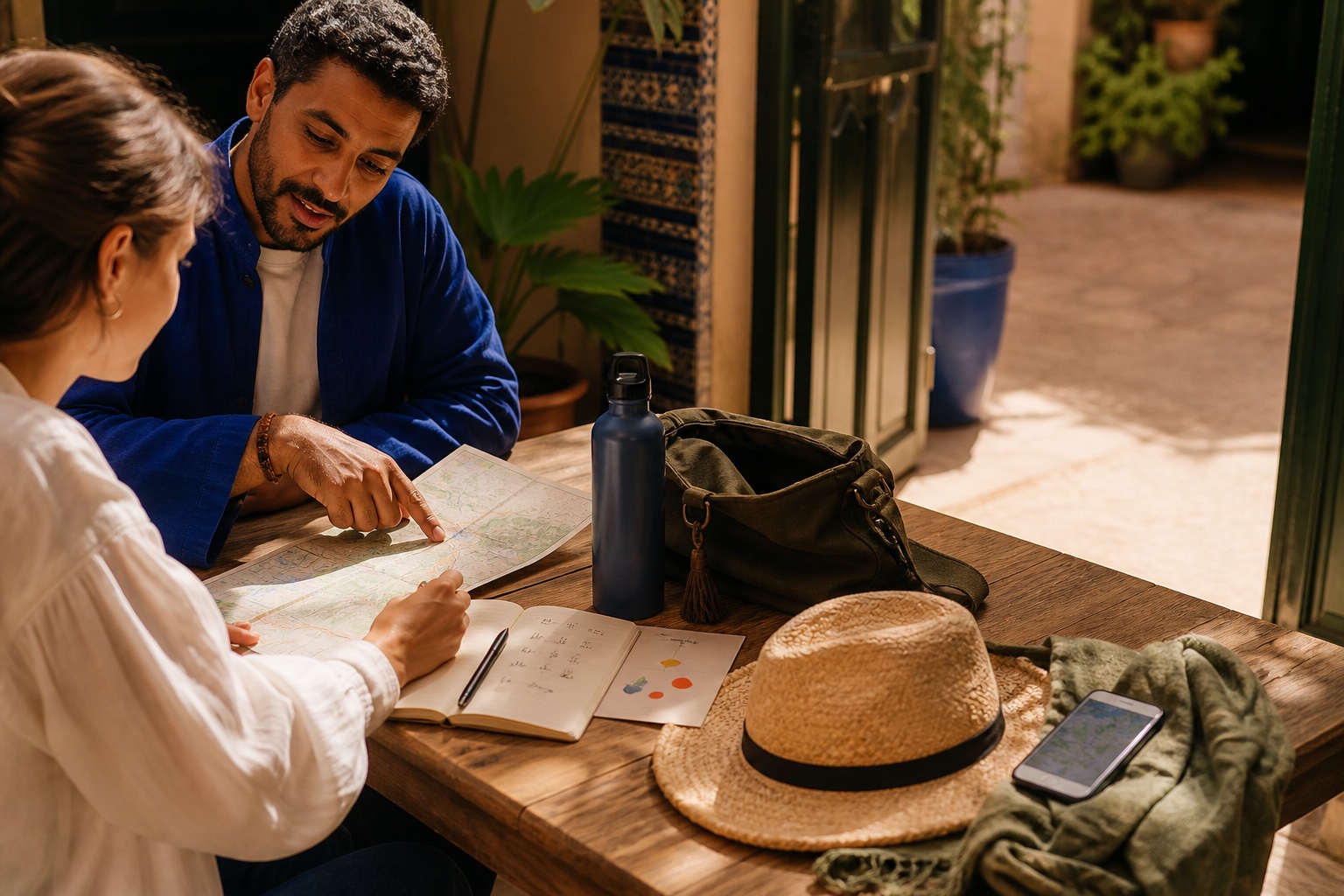
Wear clothes that respect the setting and let you learn safely. For Moroccan cities and homes, loose, adaptable coverage is a practical starting point. For kitchens, studios, surf and mountains, the activity adds its own rules. One packing list cannot serve a medina calligraphy lesson and a High Atlas route.
Dress for the actual day
Before packing, identify:
- City street, family home, school, studio, religious area or outdoor site
- Weather and time of day
- Standing, sitting, walking, water or tool use
- Dust, dye, clay, oil, heat or food
- Provider equipment and changing facilities
- Your mobility, sensory and comfort needs
Modesty, safety and comfort can support each other. They are not a costume test.
Cities, homes and religious areas
Morocco is a Muslim-majority country with varied local and personal practice. Current official travel advice asks visitors to respect local traditions and be especially considerate during Ramadan and near religious areas.
Loose clothing that covers shoulders and reaches around the knees or lower is a flexible choice in many contexts. Carrying a light layer can help with sun, cool evenings and a more conservative site or household invitation.
But ask the host when the venue has specific expectations. A private art studio, surf camp, rural home and mosque-adjacent route are not the same setting. Access to religious sites also varies; clothing does not itself grant entry.
Cooking sessions
Cooking clothes should support hygiene and heat safety:
- Closed, stable shoes
- Hair secured where needed
- Sleeves that do not trail near flame or food
- Minimal loose jewellery
- A washable layer or apron
- Provider-supplied protective equipment when appropriate
Tell the host about mobility, grip, heat sensitivity or the need for seating. A beautiful kitchen with a high work surface may still be difficult to use.
Craft studios
The craft changes the clothing:
- Clay and dyes can stain.
- Leather, paint or adhesives may involve odour and ventilation.
- Zellige cutting and metal work need close tool supervision and suitable eye/hand controls.
- Loose scarves, sleeves or jewellery can become hazards near moving tools or flame.
- Closed shoes are sensible where pieces, tools or wet surfaces are present.
Ask what the provider supplies. Do not bring improvised protective equipment and assume it makes an unverified workshop safe.
Surf, coast and changing privacy
For surf and water sports, confirm wetsuit or swimwear expectations, changing facilities, footwear, sun protection, towel/storage and transport. Coastal settings vary. A provider should describe the practical arrangement rather than leave learners to guess at the beach.
If a learner needs a women-only session, private changing space or a particular suit arrangement, ask before paying. Availability should be confirmed, not implied from a stock photograph.
Mountains, desert and winter
Outdoor clothing follows current conditions, route and guide advice. Layers, sun protection, footwear, water and night warmth may matter differently across the Atlas, Middle Atlas and Sahara.
Do not use a generic “Morocco is hot” assumption. Higher elevations and desert nights can be cold. Heat events and weather changes require current checks. See when to learn by skill and the suitability guide.
Workshop manners matter more than perfect clothes
Useful etiquette is practical:
- Arrive at the agreed time and place.
- Ask before handling tools, materials, household objects or finished work.
- Do not interrupt paid production for a photograph.
- Ask before photographing or recording any person.
- Respect a “no,” even when another visitor was allowed.
- Keep cultural and family stories in their agreed context.
- Buy only if you want to; do not treat shopping as the required price of hospitality.
- Do not reproduce or market a practitioner’s design without permission.
UNESCO’s living-heritage ethics emphasise dialogue, consent and the interests of practitioners and communities. Good manners are not decorative. They protect the relationship that makes learning possible.
The Activity Packing Card
| Question | Your answer |
|---|---|
| What activity and exact venue? | |
| What is the current weather/condition? | |
| What clothing does the host require or supply? | |
| Are tools, heat, food, dust, water or animals involved? | |
| Is changing/privacy available? | |
| What access or sensory adaptation is needed? | |
| What photography rule applies? |
Fill this from current provider and official information. “Comfortable clothes” is not enough when the activity has real equipment or cultural context.
The best outfit is the one that lets you focus on the lesson, respects the people sharing it and survives a small disagreement with saffron, clay or Atlantic spray.
Pack for the learner role
A sightseeing outfit and a working outfit solve different problems. Loose sleeves may look elegant but become troublesome near flame, wheels or tools. Open sandals may suit a riad courtyard and fail in a pottery studio. A heavy camera bag can turn a medina learning walk into shoulder training.
Before packing, finish this sentence: “During the session I will be…” Kneading, cutting, paddling, walking, sitting low, climbing stairs and visiting a home each imply different clothes.
Clothing questions by skill
Cooking and food
Ask whether the session uses open flame, hot oil, market walking or low preparation surfaces. Wear secure shoes and clothes that can tolerate ingredients. Tie back long hair. Confirm whether aprons are provided and whether jewellery needs removing.
Clay, zellige, leather and metal
Dust, glaze, dye, water, sharp edges and hammering may appear. Ask for the provider’s protective-equipment rule. Closed footwear and fitted sleeves are often more useful than an expensive “artisan” outfit bought for the photograph.
Surf and wind sports
Confirm wetsuit or rash-vest provision, changing privacy, sun protection and the walk to the water. Bring secure layers for before and after the session. Atlantic wind has never been impressed by a perfect beach look.
Walking, mountain and desert learning
Use current conditions, altitude and route surfaces. Layers matter because mornings, shade, wind and evenings can differ sharply from midday. Ask whether the activity involves scrambling, snow, loose ground, animals or long vehicle sections.
Etiquette is a conversation, not a costume
Moroccan settings differ. A family home, religious site, surf school, urban language centre and rural cooperative will not share one dress code. Ask the host for activity-specific guidance and follow requests that protect safety, privacy or cultural setting.
Do not photograph a person, home, work process or child without clear permission. A paid booking does not buy unlimited image rights. Ask before moving tools, touching materials or entering working areas. If tea arrives during a lesson, enjoy the hospitality without assuming it has replaced the teaching block.
Simple courtesy travels well: greet people, arrive on time, listen to the safety explanation and make space for the practitioner’s real work. You do not need to perform “Moroccan manners.” You need to behave like a respectful guest who came to learn.
Keep one clean layer available after messy work, and carry a small bag for wet or dusty clothing. Ask before borrowing protective equipment from another learner. If the host gives a specific instruction, use it over a generic packing list: they know the room, tools and current weather better than the internet does.
Evidence
Selected references
Official and institutional references used for place, heritage or practical context. Commercial operators and marketplaces are kept in our private research ledger rather than promoted here. Reviewed 15 August 2026.