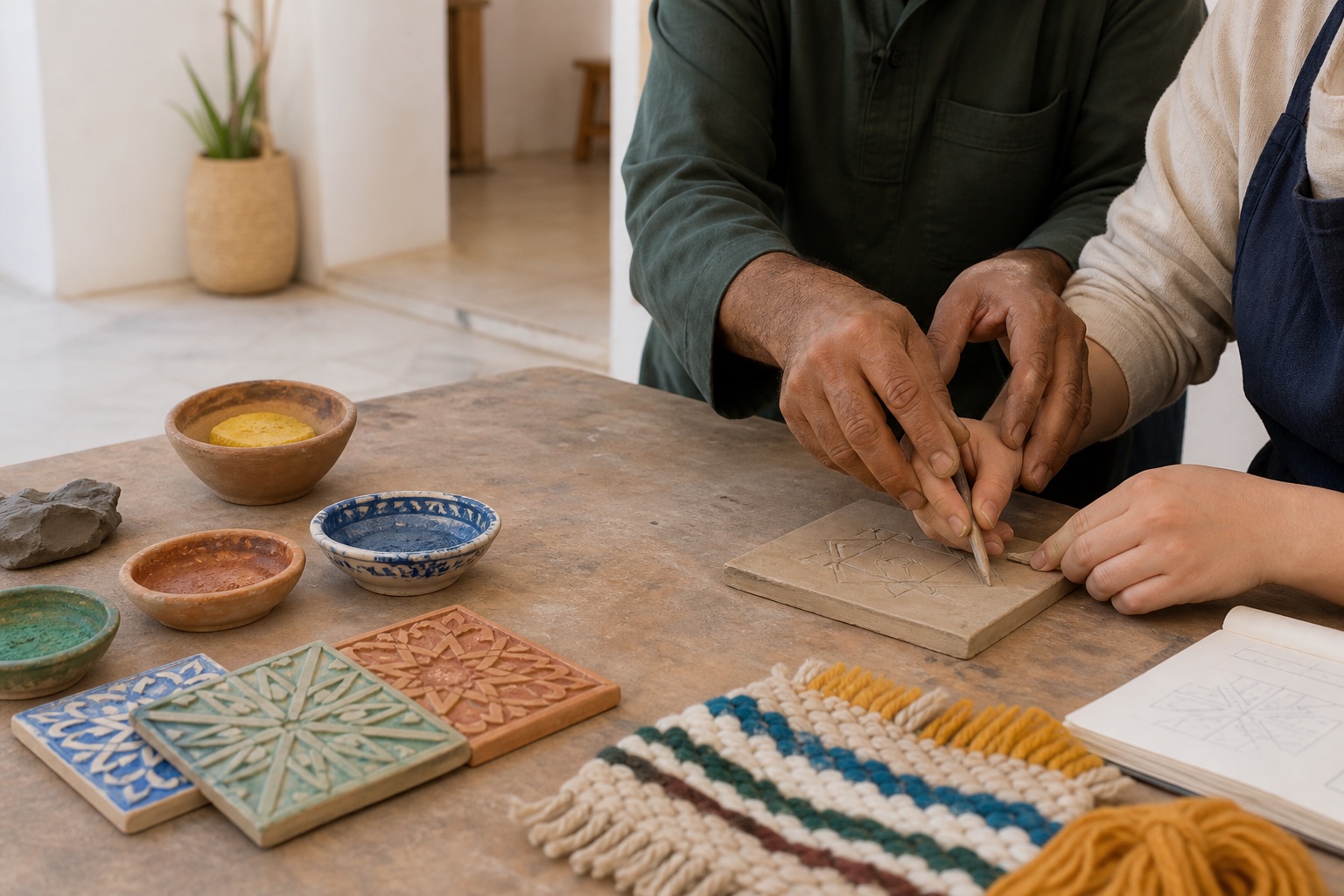
A fair-looking price does not prove fair pay, and a low price does not prove exploitation. Compare what the learning experience actually contains: teacher time, active practice, materials, venue, transport, food, accommodation, finishing and cancellation terms. Then ask directly how the practitioner is compensated.
The headline price is only one number
Two workshops can share a title while offering very different value.
One price may include a private teacher, materials, transport, lunch and a finished object. Another may cover a group demonstration with materials charged later. A multi-day programme may include accommodation but only a few active teaching hours.
Before comparing, split the price:
| Cost component | What to ask |
|---|---|
| Teacher or artisan time | Who teaches, for how long and to how many learners? |
| Active learning | How much time belongs to participant practice and feedback? |
| Materials | What quality and quantity are included? |
| Finishing | Are firing, drying, backing, collection or shipping included? |
| Venue | Studio, school, home, hotel, shop or outdoor site? |
| Transport | Pickup, return, rural transfer and equipment handling? |
| Food | Meal, tasting, ingredients and dietary adaptation? |
| Accommodation | Room type, occupancy and single supplement? |
| Terms | Deposit, balance, cancellation and weather/provider fallback? |
This is not accounting for the joy of mint tea. It is making sure tea is not hiding two missing teaching hours.
Compare inclusions before totals
Ask for a written inclusion list. Pay special attention to costs tied to the promised outcome.
If a pottery object needs firing, who handles it and when can it be collected? If zellige assembly needs backing and drying, can it travel that day? If a rug sample uses prepared fibres, are those included? If the class starts in Marrakech but teaches in a rural home, is the transfer included?
An output is not automatically better. Some serious learning sessions produce notes or practice rather than a souvenir. The important point is that the description and price agree.
Tipping is not the wage
Visitors often ask for a universal tipping percentage. This guide does not invent one.
Different venues, providers and group arrangements handle gratuities differently. Before the session, ask:
- Is the teacher or artisan already paid from the advertised price?
- Is a tip optional?
- If several people teach, cook, translate or drive, how are tips shared?
- Can a tip be added electronically or is cash expected?
- Does the provider give guidance without applying pressure?
A practitioner’s fair compensation should not depend entirely on whether a visitor understands an unwritten rule. Tipping can express appreciation. It should not repair an opaque commercial model.
Cultural knowledge has interests as well as costs
UNESCO’s ethical principles say communities and practitioners should have a primary role in safeguarding living heritage. They should be involved through transparent dialogue and informed consent. They should also benefit from the material and moral interests connected to use, documentation, promotion or adaptation of their heritage.
For GoLearnTo, that creates questions—not a magical “ethical” badge:
- Did the practitioner agree to the teaching format and description?
- Are they named and attributed where they wish to be?
- Who receives the customer payment?
- Can they limit photography, recording or design reproduction?
- Does the workshop protect teaching time from sales pressure?
- Can the practitioner correct how their knowledge is represented?
The answers may be commercially private. The provider should still be able to explain the model credibly.
Currency, deposits and written terms
The Moroccan dirham is the official currency. Official visitor information explains that card acceptance varies and cash remains useful in some settings. Do not rely on a static exchange rate copied months ago.
For every enquiry, confirm:
- Price and currency
- Tax or booking fee
- Deposit and payment recipient
- Balance timing
- Card, cash or transfer method
- Refund and cancellation rules
- Provider cancellation or teacher substitution
- Weather/condition cancellation
- Finishing, collection and shipping charges
Keep the confirmation. A friendly WhatsApp conversation can still produce a written summary.
The True Cost of Learning table
Use one row per candidate:
| Candidate | Teacher & active time | Materials & output | Travel/stay | Access & safety | Terms | Practitioner benefit evidence |
|---|---|---|---|---|---|---|
| A | Named / stated | Included / finishing unclear | Pickup included | Partly answered | Written | Direct provider answer pending |
| B | Teacher unknown | Materials extra | Independent | Not stated | Flexible claim only | Not explained |
Do not invent scores when the answer is unknown. “Unknown” is useful. It becomes the next enquiry question.
What GoLearnTo will and will not claim
We can report a current published price with its source and date. We can show inclusions and unresolved questions. We can ask how the practitioner is paid and record the provider’s answer.
We cannot declare a universal fair price for Moroccan labour or culture. We cannot assume a cooperative structure, fair wage or community benefit from a name or photograph. We cannot promise that the most expensive experience is the most responsible.
Use the workshop guide, then compare the full proposition. Fairness begins with transparency, not a percentage added at the end.
Compare like with like
Two cooking classes may share a title and little else. One price may include market guidance, private transport, ingredients, three hours of active cooking, lunch and recipe notes. Another may cover a group demonstration and tasting. The cheaper number cannot be judged until the format is visible.
Use a per-learner comparison only after recording:
- Active teaching and feedback time
- Group size and teacher ratio
- Materials, ingredients or equipment
- Transfers and meeting arrangements
- Meals, accommodation or finished objects
- Taxes, card charges and currency conversion
- Cancellation and minimum-group terms
Do not turn the calculation into a race to the lowest hourly price. A craft practitioner’s preparation and finishing work may happen outside your visible session. The purpose is transparency, not squeezing every human contribution into a stopwatch.
Ask where the money goes without inventing the answer
For community, cooperative or heritage claims, request specifics. Who receives the booking? Who teaches? Is an interpreter paid separately? Does the artisan set the fee? Are materials purchased locally? Does “supports the community” mean wages, a contribution or simply shopping in the area?
A provider may have a good arrangement without publishing every financial detail. Record what it can confirm and leave the rest unresolved. A cooperative-sounding name is not proof of cooperative governance.
Tipping in a learning relationship
If a provider says tips are customary, ask whether staff and practitioners already receive an agreed payment. A tip can express thanks for excellent service. It should not rescue a business model that failed to price the teacher’s work.
Carry small denominations only if current local guidance and your own preferences support it. Never let a prewritten percentage override context. The cleanest experience is one where the core work is paid properly, the full price is clear and any extra remains genuinely optional.
Evidence
Selected references
Official and institutional references used for place, heritage or practical context. Commercial operators and marketplaces are kept in our private research ledger rather than promoted here. Reviewed 15 August 2026.