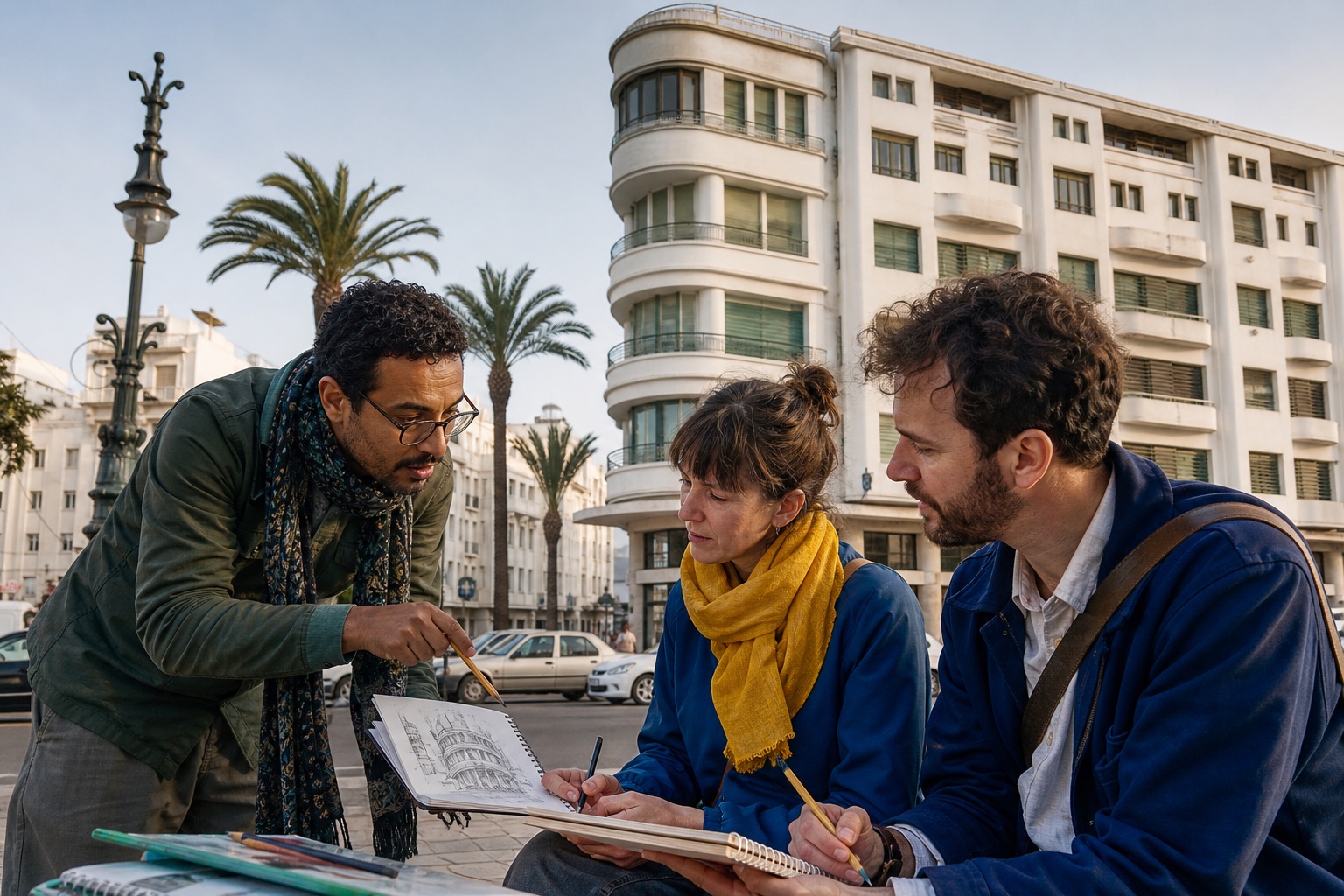
Casablanca rewards travellers who look beyond the airport and business skyline. Read twentieth-century architecture, trace layered social histories and practise contemporary Darija. Explore modern workshops, then follow the Atlantic coast to the real beach used for your surf lesson.
Casablanca offers ten credible learning routes. This guide separates city workshops from out-of-town pickup labels, multi-year study from short visitor classes, and guided interpretation from hands-on making.
Choose your Casablanca learning route
| If you want to… |
Start with |
What to ask |
| Practise Moroccan Arabic |
Arabic and Darija |
In-person visitor format, teacher and feedback |
| Prepare a Moroccan dish |
Cooking |
Exact kitchen, chef, hands-on stages and allergens |
| Read the city through food |
Food walks |
Route thesis, guide, vendor consent and interpretation |
| Shape clay |
Pottery |
Studio, active practice, drying and firing outcome |
| Decode the modern city |
Architecture |
Sources, route, observation prompts and access |
| Connect social histories |
History |
Named guide, evidence and respectful site boundaries |
| Learn in Atlantic conditions |
Surf coaching |
Actual beach, level, ratio, rescue and no-session plan |
| Practise letterforms |
Calligraphy |
Visitor format, calligrapher, script and corrected strokes |
| Understand cut-tile geometry |
Zellige |
hands-on stages, safe tools and cultural attribution |
| Study production craft |
Woodworking |
Visitor tuition—not employee training or factory display |
Calligraphy, zellige and woodworking all belong in Casablanca. However, we have not found short visitor workshops that name the teacher, hands-on task, duration and current contact.
City, metro or region?
The city guide owns central Casablanca, Anfa, Habous, the old medina, Maarif, Oasis, Ain Diab, Casa Anfa and city institutions. Dar Bouazza and Jack Beach sit outside central Casablanca. Mohammed V Airport belongs to the Nouaceur area and is an arrival node, not a classroom neighbourhood. El Jadida, Azemmour, Mohammedia and Benslimane are separate destinations.
Find the teaching address or beach before arranging transport, especially when a listing uses the broad Casablanca–Settat label. Travel time can change the shape and value of the day.
Urban Lab → Living Practice
Casamémoire describes the city as an experimental laboratory of twentieth-century architecture and publishes heritage education, routes and field-based training. That supports architecture learning. It does not mean every guided walk is a practical workshop.
A worthwhile architecture route gives you something specific to investigate. You might compare a plan with the street, identify later alterations or follow how conservation changed one neighbourhood. The guide should explain the source behind each interpretation.
Tour, table or technique?
Casablanca food offers often combine a market visit, neighbourhood walk, hosted meal and cooking. These are four different experiences. A route can teach ingredient geography and urban food history without cooking. A hosted meal can support exchange without becoming a class. A class needs meaningful preparation, supervision, feedback and something you can repeat at home.
One host publishes about an hour of cooking inside a longer experience outside Casablanca. A hotel offers another class by advance request. Check the kitchen, transfer and hands-on cooking time when planning your date.
One school teaches Darija and Modern Standard Arabic through practical conversations and everyday situations. Its published courses lean online and longer term, so ask whether a short in-person Casablanca format runs on your dates.
Ask whether the course teaches Darija or formal Arabic and how your level is assessed. You should know the teacher-led hours and how feedback works. Prepared phrases let you practise politely without placing pressure on strangers.
School, studio or visitor session?
The Academy of Traditional Arts teaches calligraphy, zellige, plaster, wood and related disciplines in formal programmes. Its calligraphy course lasts two years across four semesters, so do not mistake the institution for a drop-in visitor workshop.
Local workshops show how much planning sits behind cabinetry, carving and mother-of-pearl inlay. A professional training workshop may not be open to visitors, so check before travelling across the city. Meanwhile, the craft guides explain the materials and techniques worth looking for.
Air-dry, fire and carry
A direct pottery lead publishes beginner formats of roughly one and a half to two hours and distinguishes air-dried from fired outcomes. That distinction matters. Air-dried clay is not the same durable object as kiln-fired ceramic. A fired piece may require drying, glazing, firing, collection or delivery after the traveller leaves.
Ask what you will shape, how often the potter corrects your technique and what can travel home. Use the kiln-firing glossary before accepting a vague promise that your piece will be “finished later.”
Architecture, mosque and museum are different classrooms
The Hassan II Mosque’s official guided route interprets spaces, history and materials including carved wood, zellige, marble, tadelakt and copper. The Museum of Moroccan Judaism provides another social-history layer from its Oasis setting. Neither automatically teaches a craft.
A strong history route connects its story to a building, collection, archive, neighbourhood or oral account. It should also explain respectful dress, worship access, opening hours, photography and group conduct before the walk begins.
Choose the right Casablanca beach
Official city material supports an Ain Diab surf-school ecosystem. A direct surf lead describes its school as precisely in Dar Bouazza and publishes level-based lessons and ratios. Dar Bouazza can work as a surf day from Casablanca, but allow for the journey and use the correct meeting point.
“Surf Casablanca” can mean Ain Diab, Dar Bouazza or another nearby beach. The school should name the meeting point, explain why the conditions suit your level and keep the group manageable. Ask what happens when the ocean is unsafe.
Check the date on cultural programmes
Jazzablanca ran from 2 to 11 July 2026, and the Casablanca Arab Film Festival ran from 17 to 24 July 2026 with edition-specific learning activity. These dates prove a living cultural ecosystem, not a permanent music or film course. New profiles require future dates, named tutors, learner tasks and current enquiry routes.
Casablanca is visually rich, but we found photo tours and national itineraries rather than a city workshop with an assignment and image review. Enjoy the city with your camera, but do not expect tuition without a named teacher.
Ask these before you enquire
- Exact city, metropolitan or regional teaching site
- Current legal operator and named practitioner, guide or instructor
- What you do, active time, feedback, repeat and useful result
- Group size, language, level, access and safeguarding
- Food, clay, kiln, tile, wood, tool and sea controls
- Worship, museum, neighbourhood, artisan and vendor consent
- Transport, collection, delivery, weather and no-session terms
- Explicit alcohol-free venue, recipes, route and inclusions
- Current dates, price, deposit and cancellation
The possible hosts below have not confirmed live availability or a partnership with GoLearnTo. Their open questions show what to ask about the teacher, venue, lesson and price before arranging anything.
Keep exploring Morocco
Return to Morocco, compare craft depth in Fes, or examine how reconstruction shapes learning in Agadir. Casablanca’s advantage is not that it contains every Moroccan tradition. It is that the modern city makes you ask who teaches, where the practice occurs and which urban layer you are actually reading.
Enquire with the useful details
Tell GoLearnTo the skill, dates, starting level, preferred language and any access, dietary, material or water-confidence needs. An enquiry asks for information or an introduction; it does not confirm availability, verification, safety or suitability.
What we checked
Sources behind the local details
We used these sources for local history, geography and cultural context. Opening times, access and programmes can change, so confirm current details with the venue or host. Sources checked on 14 August 2026.
- Moroccan National Tourist Office
- UK Government travel advice