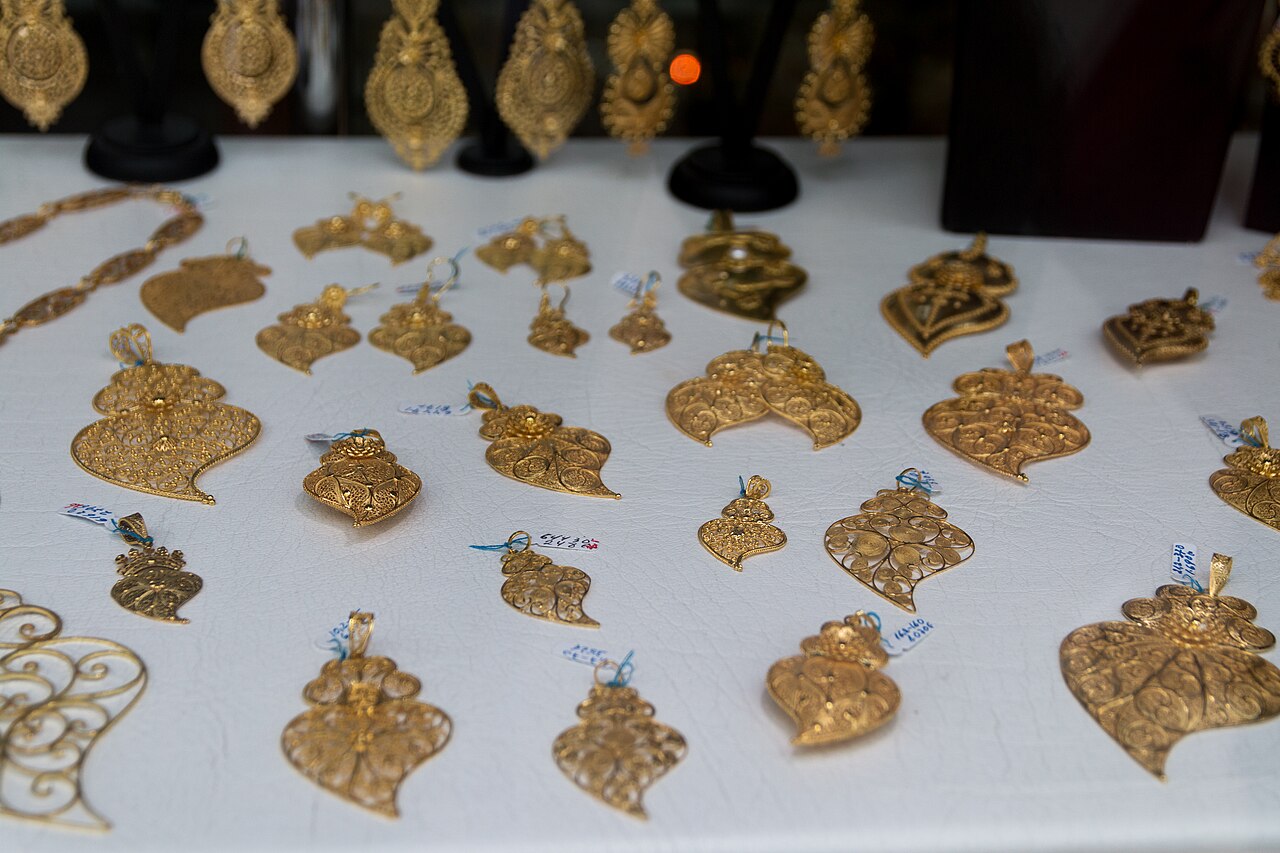

Portuguese filigree is fine metalwork built from delicate wire, often twisted, arranged and joined into intricate forms. Northern Portugal has strong cultural grounding for the practice, especially Gondomar and Póvoa de Lanhoso. Choose a teaching studio when you want to work alongside the goldsmith.
Filigrana de Gondomar entered Portugal’s National Inventory of Intangible Cultural Heritage in 2023. The record treats it as a living system of skills and working relationships, not simply a heart-shaped souvenir. Gondomar remains a major centre of Portuguese goldsmithing, with active workshops in several parishes around the municipality.
Watch the sequence before naming the lesson
A goldsmith may demonstrate wire preparation, twisting, flattening, shaping, soldering and finishing. Heat, tools and valuable material can limit which stages you safely attempt. A good workshop tells you exactly what is pre-made and what will pass through your own hands.
Gondomar is especially associated with filigrana de integração. The maker first builds an outer frame and internal structure. Very fine prepared wire then fills the open spaces before soldering and finishing. In the traditional division of work recorded by Património Cultural, goldsmiths prepare frames and wire, while women known as enchedeiras fill the forms, often in home workshops, before the pieces return to the goldsmith.
If participants form a simple element, receive correction and repeat it, the session has a practical learning core. If the artisan works while visitors observe and ask questions, it is a demonstration. Both can be excellent when described honestly.
Look beyond the heart motif
The filigree heart is widely recognised, but it is not the only evidence of skill. Look for the density and consistency of the filling, the relationship between frame and interior pattern, the joins, the final surface and the way a clasp or fitting is integrated.
Ask who designed the piece and who completed each stage. That question respects the collaboration behind the work and helps distinguish an active local workshop from a retail display with no maker present.
Precious-metal work sold in Portugal should carry the appropriate responsibility and assay marks where required. A teacher can show you where to look. For a purchase, the mark and invoice provide the legal information, while the workshop story explains provenance and design.
What a beginner can really do
In 60–90 minutes, a beginner might twist or shape practice wire, fill a small prepared frame, compare tools and repeat one movement after correction. Soldering may remain a demonstration because of flame, ventilation, material cost and workshop insurance. If every difficult stage is already complete and you only attach a finding, the session is closer to assembly than filigree tuition.
Longer technical training belongs with a properly equipped jewellery school or vocational programme. A visitor workshop should promise one safe, truthful slice of the process and give enough explanation to recognise the professional skill surrounding it.
Before you choose, ask for the maker’s name, the metal and tools, the group size and the object you could realistically finish. Ventilation and eye protection matter when heat or fine metalwork is involved. A short class can give you one safe, truthful stage of the professional process; plan it around the actual workshop in Gondomar or Póvoa de Lanhoso, not a vague promise of “northern Portugal”.
What we checked
Sources behind the local details
We used these sources for local history, geography and cultural context. Opening times, access and programmes can change, so confirm current details with the venue or host. Sources checked on 21 August 2026.